Introduction1)

Discourses on practices of grassroots democracy often focus on modes of popular participation centered on institutional avenues such as elections and local governance issues dealing with decentralization, devolution, and local autonomy (Mohanty 2007, 15–32). At the local level, consequent interests are on “restraining arbitrary and corrupt official behaviour and enhancing the accountability of grassroots authorities” (Perry and Goldman 2007, 1).

In the political arena where countervailing forces operate, grassroots democracy is often related to social movements and peoples’ organizations intervening in the political process through advocacies and campaigns on regime and systems change and/or devising strategies and practices that engage with the state. For instance, farmers and rural poor in Northeast Thailand “assert their rights and demand state compensations” and engage in “direct actions towards the state (and) press their demands for corrective action” (Prasartset 2004, 140).

Even when a less state-dependent perspective is raised in terms of “participatory governance through the empowerment of communities and grassroots, the process is ultimately depicted in terms of achieving “an increased ability of the poor to effect or influence state policy” and bring about “institutional reforms” (Angeles 2004, 184). Among “civil society” groups advocating “social transformation” in the Philippines, Franco (2004, 100–1) points to “a still unrealized institutional setting where effective access to democratic governance is available to the entire citizenry . . . (and) . . . aiming to promote change by exercising citizenship power in state policy-making and implementation.”

The exercise of grassroots democracy, however, need not focus on the state and its formal institutions. The role of the state is not intrinsic to the practice of grassroots democracy. Kaufman (1997, 1) describes grassroots democracy as that which “allow people in their communities and workplaces to control their lives and livelihoods (entailing) . . . grassroots mobilization and the development of community forms of popular democracy.” In its generic sense, grassroots democracy is often equated with “popular participation” and is seen as both a goal and a method of change.

Popular participation, moreover, has an economic character. Parameswaran (2008, 127), notes that participation can be strengthened by “(a) giving primacy to the primary sector and, fragmentation of ownership, and collectivization of operations; (b) relying on small-scale, but efficient industries, rather than on mega enterprises; (c) making small not only beautiful but also powerful and thus (d) making local economies strong enough to withstand the onslaught of global economies.” This dimension of grassroots democracy where the state and state-related matters recede in importance and focus remains relatively unexplored and have not been given the proper attention they deserve.

This alternative framework looks at how the poor and their communities have (through the ages) been able to manage their own lives through mechanisms that lie outside the formal systems of governance and economics. This sector encompasses political, economic, social, and cultural aspects. The list of alternative practices could be enormous and include, among others, (1) age-old but tried and tested production and distribution systems, (2) local decision-making processes, (3) informal land market mechanisms, (4) local credit systems (not usury), (5) concepts of common and individual property rights, (6) notions of justice and entitlement, (7) non-formal and folk education, (8) indigenous health care systems, (9) local cultural norms and belief systems, (10) everyday forms of resistance, etc. In contemporary times, there are efforts by poor and marginalized peoples sidestepping and even violating established legal processes and institutions, e.g., unilaterally taking control of land and other resources to create self-sustaining and viable socio-political and economic communities.

The Program on Alternative Development of the University of the Philippines Center for Integrative and Development Studies (UP CIDS AltDev) recognizes the value of grassroots democracy as depicted in the alternative practices on the ground. For the past three years, UP CIDS AltDev has been researching case studies of practices in Southeast Asia and have documented and published around sixty of such cases.2)

More than simple documentation and publication, UP CIDS AltDev has brought practitioners together in three annual Southeast Asian regional conferences where experiences from the ground are shared, exchanges undertaken, challenges identified and lessons learned. The ultimate goal is to establish a new network based on regionalism and transnationalism from below that would challenge the dominant elite-centered and oligarchical-controlled regionalism as exemplified by the Association of Southeast Asian Nations (ASEAN).

Southeast Asian Alternative Practices3)

The following three cases of alternative practices illustrate grassroots democracy at work in Thailand, Indonesia, and Timor Leste. They represent efforts by rural communities to practice grassroots democracy in all its dimensions and iterations while asserting their autonomy in building sustainable lives for the peoples.

Southern Peasants’ Federation of Thailand (SPFT).

Inequitable land distribution in Thailand has endured over the years because of the concentrated land management of the Thai state. In addition, capitalist development has commodified land to serve a market economy. The Thai state facilitated the private sector cultivation of cash crops such as oil palm on state-owned lands to respond to the global demand for industrial crops. In Surat Thani Province, Southern Thailand, landless and small-scale peasants have employed alternative economic, political, social, and cultural practices to counter state-centric land management.

In 2003, Thai farmers discovered that around 11,200 hectares of land concessions for oil palm plantations had already expired. Established in 2008, the SPFT has led landless peasants and workers in Surat Thani province, southern Thailand, to unilaterally occupy portions of these lands, establish new community settlements, and to demand equitable land distribution. Their community members, however, have been subjected to intimidation, illegal detention, eviction, death threats, and killings believed to be perpetrated by a real estate mafia and agribusiness interests.

Despite these challenges, they continue to apply their idea of a community land title deed underpinned by the concept of community rights to land and natural resources management. Alternative practices of land management including diversified farming employed by SPFT community members call for participatory development and governance. In alliance with the People’s Movement for a Just Society (P-Move), the SPFT continues to struggle for land rights and advocate redistributing land equitably among landless peasants in Thailand.

In 2020, the COVID-19 pandemic tested SPFT’s self-reliance even as they were deprived of sufficient government relief measures and protective equipment due to the lack of household registration records. Their grassroots-level practices of alternative land management and sustainable food production consisting of collective farming of food crops, goat raising, dairy production, and establishing a rice bank enabled them to build a social safety net and remain food sufficient and resilient against the pandemic.

Serikat Petani Pasundan (Pasundan Peasant Union, SPP), Indonesia.

Officially established in 2000, the history of agrarian struggles by SPP actually goes back to the 1980s, when student movements in Garut, Indonesia were at the forefront of promoting the rights of the farmers on agrarian reform and environmental conservation. This eventually led to the formation of SPP, whose membership spread to Pangandaran, Tasikmalaya, and Ciamis in West Java (Pasundan is the historical name). The Union’s expansion enabled it to take on other issues, such as democratization and the promotion of people’s well-being in the community.

SPP’s vision is to “develop or build structures of economic social politics based on values and principles of humanity, infinity, and justice” (Kartini 2019). To attain this vision, SPP has adopted goals, strategies, and activities that promote grassroots democracy in the community and in the whole of society and, in particular, support the control and management by local communities over their common resources.

SPP staged land occupations and reclamation of publicly-owned rubber plantations in West Java and managed to undertake various economic and social projects including diversified farming, managing alternative schools (primary and secondary levels) that offer learning sessions on agriculture and on agrarian law, fair trade exchanges, a community-managed eco-tourism in Pasundan, as well as a local coffee shop in Jakarta that sources its coffee from its many coffee farming communities across the country.

During the COVID 19 pandemic, SPP co-organized the food solidarity movement called Gerakan Solidaritas Lumbung Agraria (Gesla) or Agrarian Food Barn Solidarity Movement. They distributed free food to members of fraternal organizations in Bandung and Jakarta and other parts of Indonesia. This is amplifying their local wisdom of cooperation based on the most common system called beras perelek, in which a farmer saves a cup of rice a week in a bamboo tube that is later collected by the community to help others or sell the accumulated rice savings to purchase communal facilities.

Uniaun Agrikultores Munisipiu Ermera (UNAER), Ermera District, Timor Leste

Under both Portuguese colonialism from the 16th century to November 1975 and Indonesian occupation from 1975 to 1999, the Timorese local communities were prevented from performing their own conservation management efforts and maintaining social cohesion. The Indonesian occupation not only depleted resources but also weakened traditional social structures that prioritize the communities’ capacity to manage and protect their land and natural resources. Bombings and forced resettlement also contributed to adverse environmental and social changes.

UNAER is an agricultural organization based in the Ermera municipality of Timor Leste. Founded in 2010, UNAER organizes farmers in the district for mobilizations and dialogues with government officials to defend their rights over the land as mixed-race (mestizo) families continue their claims over huge coffee farms in the area. They justify their unilateral land occupations due to the absence of a national agrarian reform policy and the fact that the occupied areas are part of their ancestral domain. The occupied lands were distributed among the community members.

In post-conflict Timor Leste, the customary practice known as the tara bandu, achieved strong resurgence for local decision making, collective action, enforcement system, and agrarian reform implementation. It was observed that community-based actions using the tara bandu were more effective in undertaking alternative development. The practice consists of organized rituals, building of altars, and the use of natural objects in implementing agroecology principles and enforcing local laws such as prohibition of harvesting of natural resources in protected areas. Ermera, the country’s largest area for coffee production, has become a model for tara bandu implementation at the district level.

Conclusion

The Thai, Indonesian and Timor Leste cases presented here are but a fraction of countless grassroots initiatives in Southeast Asia that demonstrate the capacities of empowered and organized communities to assert their rights to land, livelihood, and political decision-making that are exercised outside of the state framework. Utilizing principles of solidarity, sharing, cooperation, the commons, collectivity, and the judicious use of traditional customs, the communities are able to remain resilient even in pandemic times. Challenges from the state, rural elite, and corporate interests continually hound them but they have remained steadfast in their advocacies and campaigns.

References

Angeles, L.C. 2004. Grassroots democracy and community empowerment. In Democracy and civil society in Asia, Vol. 1, Globalization, democracy and civil society in Asia. F. Quadir, and J. Lele (eds). New York: Palgrave Macmillan, 182–212.

Franco, J.C. 2004. “The Philippines: Fractious civil society and competing visions of democracy.” In Civil society and political change in Asia: Expanding and contracting democratic space, M. Alagappa (ed). Stanford, CA: Stanford University Press, 97–137.

Kaufman, M. 1997. Community power, grassroots democracy, and the transformation of social life. In Community power and grassroots democracy: The transformation of social life. M. Kaufman, and H.D. Alfonso (eds) London & New Jersey: Zed Books, 1–26.

Kartini, Erni. 2019. “Serikat Petani for Humanity, Infinity, and Justice.” Presentation at the 2nd International Conference on Alternatives: Building Peoples’ Movements in Southeast Asia, Quezon City, Philippines, October 22–24, 2019.

Mohanty, M. 2007. Introduction: Local governance, local democracy and the right to participate. In Grassroots democracy in India and China: The right to participate, ed. M. Mohanty, R. Baum, M. Rong, and G. Mathew. New Delhi: Sage, 15–32.

Parameswaran, M.P. 2008. Democracy by the people: The elusive Kerala experience. Bhopal: Alternatives Asia.

Perry, E.J., and M. Goldman, eds. 2007. Grassroots political reform in contemporary China. Cambridge and London: Harvard University Press.

Prasartset, S. 2004. “From victimized communities to movement powers and grassroots democracy: The case of the Assembly of the Poor.” In Democracy and civil society in Asia. Vol. 1, Globalization, democracy and civil society in Asia, ed. F. Quadir, and J. Lele. New York: Palgrave Macmillan, 140–181.

Tadem, Eduardo C. 2012. “Grassroots Democracy, Non-State Approaches, and Popular Empowerment in Rural Philippines.” Philippine Political Science Journal. (Vol 33 No 2)

Tadem, Eduardo C., Karl Arvin F. Hapal, Venarica B. Papa, Ananeza P. Aban, Nathaniel P. Candelaria, Honey B. Tabiola, Jose Monfred C. Sy, and Angeli Fleur G. Nuque. 2020a. “Deepening Solidarities beyond Borders among Southeast Asian Peoples: A Vision for a Peoples’ Alternative Regional Integration.” UP CIDS Discussion Paper 2020-04. Quezon City: University of the Philippines Center for Integrative and Development Studies.

Tadem, Eduardo C., Ananeza P. Aban, Karl Arvin F. Hapal, Venarica B. Papa, Nathaniel P. Candelaria, Honey B. Tabiola, and Jose Monfred C. Sy. May 2020b. “A Preliminary Report on Southeast Asian Community and Grassroots Responses in Covid-19 Times.” Quezon City: University of the Philippines Center for Integrative and Development Studies.

UP Center for Integrative and Development Studies Program on Alternative Development (UP CIDS AltDev). 2020. “Alternative Practices of Peoples in Southeast Asia Towards Alternative Regionalism.” UP CIDS Workshop Proceedings. Quezon City: University of the Philippines Center for Integrative and Development Studies.

Tadem, Eduardo C., Benjamin B. Velasco, Ananeza P. Aban, Rafael Vicente V. Dimalanta, Jose Monfred C. Sy, Micah Hanah S. Orlino, Ryan Joseph C. Martinez, and Honey B. Tabiola. 2022. “Southeast Asian Peoples in Pandemic Times: Challenges and Responses COVID-19 Grassroots Report Volume 2.” Public Policy Monograph Series 2022-03. Quezon City: University of the Philippines Center for Integrative and Development Studies. Quezon City.


The article was first published by Global Taperstry of Alternatives at https://globaltapestryofalternatives.org/newsletters:09:rivers


About Author(s)

Eduardo C. Tadem, Ph.D. is the convenor of the University of the Philippines Center for Integrative and Development Studies, Program on Alternative Development (UP CIDS AltDev), and Professorial Lecturer at the UP Asian Center.


1) Excerpted with revisions from Tadem 2012.

2) The cases are published in UP CIDS AltDev’s Monographs on Alternatives (https://cids.up.edu.ph/program-on-alternative-development/).

3) Excerpted with revisions and updates from Tadem et al 2020a, Tadem et al 2020b, UP CIDS AltDev 2020, and Tadem et al 2022.

by Aram Ziai

The article is a highly interesting piece which demonstrates the author‘s familiarity with the theoretical debate about anti-capitalist revolutions as well as with current oppositional social movements. However, coming from a different theoretical tradition than the author I found its argument sometimes hard to follow and was not quite convinced by a number of theoretical claims – also in the light of its own analysis of social movements.

If the „state has to be seen as it is, a political and institutional expression of capital and totalitarian economic control“ (2), does this hold true for all states equally, including Burkina Faso under Sankara and Bolivia under Morales?

To me, a conception of state as condensation of relations of power (going back to Nicos Poulantzas) allows for more nuances – all the while bearing in mind the strategic selectivity (Jessop) of the state, which can be easier used for some purposes than for others.

In my view, the author‘s analysis shows the inadequacy of some of the more apodictic statements such as that movements either “support the politics of the State-Capital” or not: “There can be no middle ground here.” (3) I think in particular the Gilets Jaunes example demonstrates that the reality of social movements often is more complicated or contradictory than that and that non-revolutionary movements can evolve over time from demanding improvements within the status quo to demanding a new conception of politics beyond representative democracy based on capitalism.

I have to admit the main claim about revolutionary immanence has not become clear to me, as have some others. What does it mean if „movements of perpetual oppositionality have to transcend themselves“ (11)? Or even „transcend space-time“ (11)? What does „learning to see beyond the capitalist real“ (11) entail? Or even the „empirical real“ (1)? Does it presuppose that there is another, more profound, objective reality, only accessible to those versed in Marxism? Why should it be – given that the Occupy movement was heavily relying on indebted students and the Zapatista rebellion even more on indigenous peasants – that „only the proletariat can keep the rebellion going” (11)? And if “whosoever revolts against the State-Capital tyranny and for a non-state non-capital world is part of the proletariat” (11), does it not render the analysis of classes and their position within a capitalist system superfluous?

I think very interesting and important conclusions could be drawn from the empirical analysis of the text regarding revolutionary theory-building: concerning the necessity of organised movements but not of parties (and of organising vs. organisations), concerning the necessity of long-term and horizontal processes, and not least concerning the vastly different contexts in which oppositional movements arise and act. In discussing the Gilets Jaunes, Occupy and the Zapatistas, it can be demonstrated what a „belief in horizontality“ and a „disbelief in vanguardism“ (1) can mean for movements. These beliefs – an important feature of „new internationalism“ – were the result of a critical reflection of Marxist internationalism in the 20th century. Another equally important feature was the proposition that different relations of oppression are equally to be taken seriously, e.g. patriarchy and racism, which led to an abandonment of the belief that Marxism is a sufficient theoretical basis for emancipation. In my view, the work of J.K. Gibson-Graham may provide inspiration how to rethink notions of revolution in a way which is able to deal with the complexities and contradictions of questions of class and identity in the 21st century of which Marx simply could not have been aware.

by Soumitra Ghoshs

Introduction: theories of movements, but where is the praxis?

Murray Bookchin once commented that the tragedy of Marxism was that it had become a subject of cloistered academic seminars and not living movements (Bookchin 2015). Today’s anti-capitalist mobilisations do not call themselves Marxists, he observed. The recorded experiences of the various square movements, insurrections and revolutions of recent years tend to bear this out. Precious few important theoretical works have been written on these movements by grounded practitioners with Marxist backgrounds, with the notable exception of the movements in Bolivia and Venezuela. Conversely, a corpus of new, largely academic, Marxist literature has sprung up within the last decade. The overwhelming majority of today’s more revered, more widely read Marxist thinkers are academics. Though their writings offer many new insights into thepolitics, history and philosophy of old and new struggles and constitute a collective effort to reinvent and resituate Marxist theory in today’s context, they do not, in our view, work as instances of theory in practice or as something that would or could be put into practice anytime soon. It is only to be expected that any discussions of revolutionary immanence or political strategies of movements in general will be informed by readings of specific movements. This is crucial because despite a lot of commonality, no two struggles are intrinsically alike. This is not enough to say that social movements today believe in horizontality and disbelieve in vanguardism and parties or that the multitude is the new revolutionary agency in the world of biopolitical capital. Unless every facet of each specific movement process is examined in detail, such generalisations become meaningless; as a result, Marxist theories lose their uniqueness and do not really help in changing the world. If on a certain day in 2011, the New York Times front page happens to carry news of various revolutions, insurrections, movements and assemblies happening across the globe, should this lead us to infer that a global social movement is raging (Buck-Morss 2013)? Since the events making up this “global” movement are various and end equally variously, it all leads to another inference that revolutions are no longer possible but things change nonetheless through non-class popular mobilizations and non-violent resistance (Hardt 2010; Negri 2010). But what has changed precisely? Has the reign of capital been brought to an end? Has the state disappeared or stopped protecting capitalist plunder? Our uncritical belief in the empirical real —largely sensed through the audiovisual media these days — and our obsessive generalisation of the evental blind us to the very idea of immanence: we cannot see beyond the visible present.

Though this paper does not focus on the inadequacy of today’s Marxist theories, one interesting fact merits mention. While Marxist analyses and critiques of specific contemporary movements are almost entirely lacking, several not avowedly Marxist accounts do exist, written by sympathetic researchers, journalists, academics and activists alike. We refer to many of these, in addition to old and new Marxist readings, while framing our problematic about the ‘anti-capitalist’ social movements in today’s world.

Trying to frame the problematic

In order to act as agents of social and political transformation, movements of anti-capital resistance need to find the right problematic. A movement needs to situate its more immediate tasks within the wider political context (Barker 2013). For the purposes of our discussion here, this wider political context has to be understood through dialectical reasoning encompassing the follies/achievements/lessons of the past and the challenges/probabilities of the future (Marx 1869, 1891, 1895; Holloway 2002, 2005, 2010; Mészáros1995,2015; Zibechi 2010, 2015; Sotiris 2015; Barker et al. 2013; Krinsky 2013).

Our hypothesis is that movements need to distance themselves from the lure of operating within a “known” present that contains capital, state and immediate resistance (Holloway 2002, 2005, 2010, 2015; Sotiris 2015; Jay 2016). The problematic must include the state in its entirety, taking in both parliamentary democracy and its known post-capitalist revolutionary variants, which have largely been rejected by history. The state has to be seen as it is: a political and institutional expression of capital and totalitarian economic control (Marx 1869, 1891, 1895; Holloway 2002, 2005, 2010, 2015; Zibechi 2010; Marcos 2018; Sotiris 2015; Barker et al. 2013; Lenin (1917):2016).

We propose that if movements are to shift away from statism and the State-Capital hegemony, this may only be done positionally.

In other words, an all-pervading oppositional must inform every step of the process.

This oppositional is the oppositional knowledge that makes movements both necessary and possible; movements as social collectives have to know that they cease to exist as movements if they do not perpetually confront the State-Capital in its entirety. We have consciously decided to say State-Capital rather than the state and capital, because the state can no longer be viewed separately from capital nowadays (Holloway 2002, 2005, 2010; Bookchin 2015; Balso 2010; Negri 2010). The oppositional in the movement is an expression of its intrinsic oppositionality, the sum of the oppositional knowledge that transforms an event or singularity fixed in time and space into a political continuity. We argue that the knowledge of how this is being done, or would or should be done in a particular time and space — in other words, the political strategy of movements — also includes the knowledge of what was done, not only in the immediate past but also long ago. However, let us first briefly examine the generic question of “social movements” to see how oppositionality has always permeated the notion of movements.

State and society: deconstructing the “social” in social movements

In trying to elucidate the concept of “social movements”, we will follow Marx, who repeatedly expounded the duality of state and society. Society must be understood as distinctly separate from the state, which is parasitic and thus external to the former. Talking about the relationship between the state and society in late 19th-century France in The Eighteenth Brumaire of Louis Bonaparte, Marx said that the state “enmeshes, controls, regulates, superintends and tutors civil society […] through” a “most extraordinary centralisation” and that “this parasitic body acquires […] an omniscience”, finding a “counterpart in the […] actual body politic”. Marx further said that because the “excessive state machine” and “the material interests of the French bourgeoisie” are closely interwoven, the state has to “wage an uninterrupted war against public opinion”, mutilating, crippling and if possible, “amputating […] the independent organs of the social movement”.

According to Marx, society, public opinion and social movements occupy spaces that not only exist naturally outside the state and the body politic, but are also opposed to them. While discussing the momentous events of the Paris Commune, he once again said that as the “class antagonism between capital and labour” (emphasis added) intensified, the “state power” became conterminous with “national power of capital over labour” and became “a public force organised for social enslavement” and “an engine of class despotism”. Marx went on to comment that the Paris Commune reorganised “the unity of the nation” through the “Communal Constitution” and the destruction of the “state power” that claimed to be “independent of, and superior to, the nation itself”.

We can say that social movements imply oppositional reorganisation of the order enforced by power: power represented by the state in league with capital, which comes at the culmination of a process of accumulation. Wherever this process took place, it remade the actuality of society and reconstructed the very idea of social. Young Marx called it alienation: humans becoming estranged from their collective species-being as human labour was first forcibly, and then through a curious “voluntary” process no less forcible at the end, torn away from humans (Marx 1844). This caused a break, a rupture in the universality of being. As the species-being was forcibly made to lose its sense of collective subjectivity, the society that was primarily an expression of the universality of the species-being became something else (Marx 1844; Marx/Engels 1976; Mészáros 1970). However, there has always been a dialectical process of going back and forward, from the private to the collective, the self to the other, a battle against capital and the fetish its rule creates. A journey of collective assertion and anti-power, as John Holloway (Holloway 2002, 2005, 2010) says, and which we call oppositionality. The oppositional movement reinvents, reconstructs and reclaims the social by creating a new collective identity.

In Poverty of Philosophy, Marx commented that social movements do not exclude political movements and political movements cannot but be social. This means class and class struggle, because societies cannot be conceived outside the class framework as long as that framework exists. Therefore, all social movements, even those with economic demands, are also political. When we say this, we expand what Marx said (Marx 1871). To Marx, economic demands seeking resolution within the intrinsic limits of the capitalist production system are not political; the economic becomes political only when it transgresses the system. We say both are political. The first kind of politics is that of capital, hence the state. The second kind of politics is anti-capital, therefore non-state. Dialectically, the state holds the non-state within it, one kind of politics the other, which goes on to negate it (Mészáros 2015; Holloway 2002, 2005, 2010). There is no point in theorising social movements as autonomous extra-political entities that are free from enormous burdens of histories and carve emancipatory futures out of perfect emptiness. No such emptiness ever existed. All movements are the products of histories, and all human histories are of class struggles. Movements can, knowingly and also often unknowingly, support the politics of the State-Capital. Movements can also support the politics of the non-state and anti-capital; they can express and embody the non-state within the state, the anti-capital within the capital. There can be no middle ground here.

A movement, however, finds its expression through a degree of organisation. While our construct of social movements, after Marx and Holloway, as collective assertions of anti-state, anti-capital social outpouring is unlikely to meet with many challenges, the concept of organisation has always been a controversial one. What, precisely, do we mean by an organisation of the “bottom”? How does it differ, both structurally and functionally, from organisations at the “top”? When we refer generically to the “grassroots”, are we talking about structurally similar processes? What does an Adivasi (tribal) movement focused on forest and land tenure rights in an Indian forest have in common with the indigenous Aymara movement in El Alto, Bolivia or the gilets jaunes in contemporary France? Do they all represent the same social constituencies and have same demands (Krinsky 2013)? How do these movement processes function as organisations? More importantly, do they see themselves as organisations, as institutional entities? This needs to be examined in greater detail.

Social movements: the questions of organising and organisation

The representational of the Leninist party and social democracy

How to approach the questions of organisation and organising? Here, we understand organisation to refer to institutional bodies such as various communist/leftist parties, the mass processes affiliated with these, non-party social movements, and movement alliances. By organising, we mean the primary social process of the oppositional mobilising and building up various social collectives including movements, in clear distinction from organisation. This question should not be seen as a purely context-specific, strategic question or as a question that leads to inflexible political positions. The last century saw a surfeit of organisations. The revolution that embraces the complex fabric of society and emerges from its embryo (Marx 1869) became epitomised in the concept of the vanguard party, making what was merely representational and transitory (Luxemburg 1904, 1918) a political truth, or rather the only political truth. Though we are not discussing the question of parties at length here, a few words might not go amiss given that social movements have never really been far from parties, vanguard or otherwise. Moreover, of late there has been a renewed plea for the revival of Leninist parties (Dean 2012,2013, 2016; Žižek 2010), ostensibly to plug the gap between the chaos of the crowd in the streets (represented by social movements) and the immanence of emancipatory politics.

Movements, be it entire movements or just parts thereof, are constantly being transformed into parties. Inversely, parties have been known to initiate movements: the vanguard party was conceived not only to direct movements, but to ensure that movements were revolutionary enough to seize state power (Lenin 1917). As Jodi Dean (Dean 2012, 2013, 2016a, 2016b) keeps on reiterating, there can be no discussion of the left without a discussion of the party—the left is the party.

It is beyond dispute that more than social movements or even unions, parties have so far dominated the discourse of transformatory politics. We need only look at Latin America and Europe to see this confirmed: social upsurges and resistance to capital are often co-optated, resulting in a new flurry of social democracy led by the so-called new left or progresismo (Zibechi 2010, 2014, 2015; Dangl 2010; Petras/Veltmeyer 2005; Webber 2011, 2015; Modonesi 2015). Influential mobilisations tend towards party formation as a way of dealing with the political realities more effectively, which means engaging with the state. Following the footsteps of the revolutionaries of the 19thcentury, John Holloway (Holloway 2002, 2005, 2010, 2015) Raúl Zibechi (Zibechi 2010, 2014, 2015) István Mészáros (Mészáros 1995, 2015) and Alain Badiou (Badiou2010a, 2010b), among others, posit that anti-capital must be anti-state by default and that a good state is not possible. Despite this, parties flourish, and movements get tamed through involvement in statist exercises. Why does social democracy reappear, forcing us to listen to the same old litany of societies in transition, the impossibility of immediate revolutions and the pressing need for experiments with parliamentary democracy (García Linera 2006, quoted in Bosteels 2014; Webber 2015; Iglesias 2015)? Though we are no longer in the period of the Second International and communists are no longer challenging revisionists, the pattern is very familiar.

The problem is not the parties per se, but rather their emergence. Why do successful mass movements result in parties? How did the oppositional essence of the indigenous Aymara movement in Bolivia get diluted into the populism of MAS (Movement for Socialism, the party led by Evo Morales and Álvaro García Linera)? What caused the Greek people to support Syriza again, even after its betrayal in 2015(Sotiris 2015; Kouvelakis 2016)? Do people need states? Do they need to be governed, told what to do? Do we not need a better understanding of the enigma of the state? Holloway’s and Badiou’s anti-state texts do not indicate how our screams against injustices and tyranny can coalesce in ways that are strong and sustainable enough to take on the state — in other words, in conscious processes of slow organising to achieve not cosmetic, but metabolic change (Mészáros 1995, 2015). Because such processes do not just automatically emerge: the question here is whether we can transform our servile, oppressed and increasingly market-opiated subjectivities into collective revolutionary subjectivity, will or desire (the last a Lacanian derivative used by both Alain Badiou and Slavoj Žižek, as well as Jodi Dean) solely through screams, flashes of resistance and occasional inspirations? Do we not need something more coherent, relentless, vertical and yet horizontal?

Do social movements have a generic tendency to resolve opposition to the state, and new parties offer promises of this resolution? Yet movements have been known to persist outside typical party spaces, even after parties emerge and become dominant. A good example is Brazil’s Movimento Sem Terra or Landless Movement, popularly known as MST: throughout and in spite of its long-standing relationship with the PT, the Brazilian Workers’ Party, it lost none of its organisational independence, influence and relevance (Dangl 2010; Stedile 2002). Despite its earlier co-optation, the Confederation of Indigenous Nationalities of Ecuador (CONAIE) — as the October 2019 movement and its many predecessors showed — does not seem to have lost its insurrectionary potency (Zorilla 2015; Becker 2015; Zibechi2014, 2015). The movements in Argentina seem to have recovered sufficiently (Aranda 2016; Sitrin 2012; Fiorentini 2012) from the rut of the Kirchner era (Petras/Veltmeyer 2005;Dangl 2010) in 2001-2002.

Coming back to the Leninist party, it appears that the party began to replace the society and the working class as the primary site of oppositional politics (Holloway 2002, 2005; Lebowitz 2012; Luxemburg 1918; Levi 2011). Social polarities, such as a range of different classes, occupied and colonised the party that was originally supposed to act as the vanguard of a particular class, namely the proletariat. Domination of the party by class/classes became domination of society, especially in situations where the party could control the state (Lebowitz 2012; Zurbrugg 2016; Hui 2016a, 2016b). The party controlled not by the proletariat but by the ruling classes persistently pre-empted any revolutionary struggles, responding ever more efficiently and ruthlessly (Lebowitz2012; Mao 1973; Hui 2009; Chaohua 2015). The representational of the Leninist party ultimately came to signify usurpation of the social dialectic of class struggles, thus destroying the oppositionality in the oppositional.

Replacing the oppositional social with the representational of the Leninist party and social democracy also meant replacing organising with the organisation. Because the leftist practices of the last 150 years or so have thus far largely followed the “representational” and statist politics of the organisation, they have failed to critically explore the all-important question of the politics of organising. We will come back to this later.

Organisationlessness: the politics of anarchy and the apolitical of the event

If the dominant mode of leftist organising in the last century was expressed through the party, the dominant mode of revolutionary organising today appears to be under-organising and un-organisationality. Beginning with the anti-globalisation and anti-war movements of the turn of the century and continuing on through the anti-austerity movements in Europe and Latin America and finally the Occupy-type movements in the US and Europe, there has been a marked and often deliberate display of distrust in organisations, particularly structured ones such as the party (Sitrin/Azzellini 2014; Taylor et al. 2011; Clover 2016; Dean 2012, 2016). Anarchist opposition to all forms of organisations and organised processes has reappeared, particularly among the Occupy Wall Street movement, the Indignados in Spain, the street protesters in Greece and the Horizontalidad in Argentina (Sitrin/Azzellini 2014; Dean 2016). Mobilisations have become carnivals of the faceless multitude, as Michael Hardt and Antonio Negri (Hardt/Negri 2005) said. Without delving too far into whether movemental mobilisations are indeed carnivalesque in nature, we can say that today’s mobilising does have something of an “evental” and casual character (Dean 2016; Jameson 2015; Jay 2016), which is quite disturbing. Distrust in organisation is not just a historical response to the tyranny of the representational and the repressive history of party-states, it also masks a deeper absence of oppositionality. This has also been termed post-ideological and post-modern (Petras/Veltmeyer 2005; Dean 2016). The oppositional core of anti-capital seems to be holding from one movement to the next, but for how long? Movements that eschew organisational processes altogether are likely to fail in their primary task of organising the social opposition to enable it to continue beyond events. Furthermore, they tend to either become more representational than parties through their charismatic leaders (the rise of Evo Morales from Bolivia’s Aymara movement is a case in point: see Zibechi 2010, 2014) or be co-optated by big NGOs and the state (Petras/Veltmeyer 2005; Zibechi 2010).

Framing the politics of organising and organisation today

As happened in the international working-class movement in the second half of the 19thcentury and the beginning of the 20th century, organisingorganisation has become one of the most crucial political questions. While we cannot prescribe an ideal form of organising that will become the new norm, we can and must discuss the possibilities strand by strand and context by context.

It is clear that the fallacies of organising and organisation will not sort themselves out overnight: each new process of organising might inexorably result in a new organisation with new leaders and a fresh hierarchy. Movements-as-organisations, whether party or not, will be more vulnerable to co-optation by the state, as is borne out by many recent experiences from across the world: India, Argentina, Ecuador, Bolivia, Brazil, Greece and, probably, Spain. Inversely, organisations and even states have been known to initiate and foster movements by organising from below: examples include the Zapatista agricultural communes in Chiapas (Hesketh 2013; Oikonomakis 2016, 2019; Khasnabish 2010; Gahman 2016); the Rojava communes in Kurd-occupied Syria, which were inspired by the writings of social ecologist Murray Bookchin (Dirik 2016; Leverink 2015); and the “communal” Chavista state of Venezuela(Mills 2015; Foster 2015; Ciccariello-Maher 2016a, 2016b). Outside the orbits of structured organisations and any form of institutionalisation, movements have been known to remain as purely organising processes, both fluid and temporal (Zibechi 2010). The 2011 Occupy Wall Street movement, the Indignados in Spain, and the Nuit Debout movement and gilets jaunes in France all rejected verticality of organisation, though the latter showed signs of more intense organising in the form of regular general assemblies (Sitrin 2016; Gerbaudo 2016; Sourice 2016; Kouvelakis 2019; Goanec 2019). Movements can also overlap or even take the form of riots (Badiou 2012; Clover 2016; Dean 2016).

The increasingly dominant role of the new digital media in street protests and the emergence of movements-as-spectacles form another key aspect of the organising/organisation discourse. Because the advent of the new media as an oppositional proposition raises serious questions about all previous notions of organising and disrupts the process of oppositional cognition, we need to address it separately.

The new media and social movements: emancipatory digitality or disruption of oppositional cognition?

Online networks have been hailed as potentially revolutionary (Dean 2013) and described as the revolutionary “common” where the gravediggers of capital congregate (Hardt 2010; Negri 2010). The scenario of angry and disgruntled people pouring onto the streets in response to online campaigns, “viral” Facebook/Twitter posts garnering millions of hits, and social media “events” is by now familiar (Tufekci 2017; Herrera 2014). If the events are colourful, well attended and violent, the mainstream media starts paying attention and new spectacles are born. But does this scenario, which segues from one spectacle to another, across geographies, politics and culture, raise new hopes for oppositionality? Events and spectacles are usually short-lived—once crowds shrink and the state steps in with its weaponry of repression, soft containment and co-optation, the media loses interest.

Hardt claims that capitalism is producing the common and that since the autonomy of the common is the essence of communism, the “conditions and weapons of a communist project” are now more available than ever (Hardt 2010). Both Hardt and Negri (Negri 2010) further posit that capitalist production nowadays has moved from industries to the “biopolitical” and that capital is now producing new forms of life. Hardt forgets that capital has always produced new forms of life by constantly revolutionising the means of production at its disposal as well as producing and reproducing its own social relations, and that in a fully capitalised world, commons cannot survive without being oppositional. In other words, the society of commons survives in spite of and in constant opposition to the State-Capital (Caffentzis/Federici 2014). Made-to-order revolutions are not real, for all their insurrectionary flash mobs and spectacular events. They generate images, collect millions of new social media users and boost corporate profit, but do not foster oppositionality. Facebook and Twitter revolutions are real only as instances of capitalist appropriation of the process of oppositional knowledge and/or as counter-revolutions brought into being by state agencies and their imperialist backers, such as the US State Department (Herrera 2014). A revolution as a new workspace for generating corporate profit is an impossible aberration: it cannot exist.

We must be wary of spectacles. Not all insurrections are oppositional: movements without revolutionary content either lapse into stasis, reinforce the status quo or devolve into simulacra, things that are not really there. Events and their impressive visuals represent such simulacra. The illusion of revolution displaces actual oppositional action; the real is taken over by the capitalist real, thus effectively pre-empting, or acting against, the potential revolutions that take shape more gradually.

Flashmob insurrections by themselves prove nothing. Each of them must be examined critically in order to identify the social meanings behind the images and words. Because, as the Soviet linguist Voloshinov pointed out, histories of class struggles lend meanings to words and images (Voloshinov 1973). Layers of mass-produced knowledge, along with lies and fictions, must be stripped away to get at the oppositional meanings.

Below, we analyse three contemporary movements in greater detail to better understand the reality of their oppositionality.

Movements as political continuities

Gilets jaunes: from movement-as-spectacle to Revolutionary Anarchy?

The gilets jaunes (Yellow Vests) movement in France shows how a present-day social movement defies easy categorisation. It apparently started, like many such movements in the recent past, with an online petition and a couple of viral Facebook posts denouncing the tax burden on motorists and calling for a mass blockade of the roads. Before long, the leaderless movement had evolved into a full-blown and often violent revolt against President Macron and his government. The issue at stake was no longer simply the price of fuel (Harding 2019).

The thing to note here is that although they carried out a succession of “Acts” (spectacular demonstrations)[i] and managed to retain a high profile as a spectacle for an astonishingly long time (at the time of writing, the movement is 12 months old), the gilets jaunes cannot simply be understood in terms of their signature yellow vests and the sequence of violent incidents they came to represent, at least in the eyes of the Western media. Beyond the spectacle, slow day-to-day organising went on in occupied roundabouts and neighbourhood assemblies throughout France, where the gilets jaunes debated the future of the movement and interacted with citizens who might not be gilets jaunes, but were nonetheless angry and sceptical about what the Macron government was doing (Kouvelakis 2019). Local neighbourhood assemblies fed into a bigger Assembly of Assemblies, where representatives from several hundred gilets jaunes groups debated, framed and issued political demands and statements. At the time of writing, three Assemblies of Assemblies have taken place, with the third one at Montceau-les-Mines being attended by650 delegates representing 250 local groups from all over France (Goanec 2019). As the movement progressed, it gradually acquired more political clarity. No longer a Facebook-driven group that lacked a clear political agenda and counted among its members anti-immigrant right-wing sympathisers (Harding 2019) and perhaps a multitude of angry protesters and rioters (Harding 2018; Fassin/Defossez 2019), it decided to challenge not only the state, but also capital:

We are putting into action new forms of direct democracy. […] The Assembly of Assemblies reaffirms its complete independence from all political parties, trade unions […] We are inviting all people who want to put an end to the appropriation of the living […]to assume a conflictual stance against the actual system […] aware that we have to fight a global system, we believe that we must get out of capitalism. (TheYellow Vests’ Call after the Second Assembly of Assemblies in Saint-Nazaire, 5-7 April 2019—emphasis added)[ii]

The second Assembly of Assemblies, from which this exhortation emanated, was relatively poorly attended (according to the preamble to the text, only 200 delegates were present, due perhaps to systematic repression by the Macron administration and also the government’s so-called participatory democracy exercise in form of the Great Debate; see Harding 2019) and the third Assembly of Assemblies had to revisit many of the points contained in the document. Despite heated debates, there emerged a consensus on “exiting capitalism” (Goanec 2019). Moreover, some of the participants referred to themselves as revolutionaries and there was a great degree of emphasis on practising a variant of libertarian municipalism originally theorised by Murray Bookchin, though engagement with the state had not been ruled out (Goanec 2019).

It appears that while the number of gilets jaunes in the street was dwindling, the movement was consciously trying to develop itself as a better-organised process with long-term political objectives. Though some organising is still done over social media, many organisers seem to prefer direct personal interaction to Facebook, which is seen as both a “site of manipulation ‘from below’ and state surveillance ‘from above’” (Kouvelakis2019). Organising is key in determining whether the gilets jaunes will survive state repression and the cycle of media indifference and attacks. No libertarian municipalism and no revolution without a disciplined, politically informed organisation, said Bookchin (Bookchin 2015), marking a clear departure from classical notions of libertarianism or communist anarchy. From the little we know of the gilets jaunes, the evident presence of many anarchist organisers in their midst could have one of two results: the movement may remain limited to local assemblies, shunning a more organised form; alternately, desperation may push it (if not the entire movement, then some parts) towards more violent street actions.

Would we call the gilets jaunes a revolutionary movement with the oppositional knowledge of its potency? It is difficult to predict how the movement, devoid ofany regular organisation, could function as a political continuity and whether its intensely oppositional character could be maintained for long in the face of repression. This issue merits further discussion.

Occupy Wall Street and Democratic Socialism

The experiences of the Occupy Wall Street(OWS) movement show that contemporary oppositional collective processes are often structurally and politically fluid. Participants and sympathisers have written extensively about the movement/events (Dean 2016; Sitrin/Azzellini 2014; Bray 2013; Chomsky 2012; Taylor et al. 2011) that took place in 2011 and we will not linger over them here. However, a few observations might be relevant. First of all, for many of the participants, Occupy was a call for a world revolution.[iii] Though the model of the “revolution” was “imported” from the Arab Spring Revolutions in Tunisia and Egypt(White 2016) and action was initiated through social media(White 2016), from its very outset OWS targeted the global rule of capital and the economic, social and political inequality inherent in it. “We are the 99 percent” was an anti-capital slogan that directly targeted class rule (Dean 2016; Sitrin/Azzellini 2014), and the young and not-so-young people who took part in the Occupy movement in New York and elsewhere shared the common conviction that capital’s rule had to be challenged (Sitrin/Azzellini 2014; Taylor et al. 2011). OWS also re-emphasised that not only were anarchists, rather than the traditional left, emerging as the dominant voice of the left in the new movements of the 21stcentury — from the neighbourhood councils and factory takeovers in Argentina to the popular assemblies in Cairo’s Tahrir Square and the anti-austerity movements in Greece and Spain — but also that the anarchist idea of direct neighbourhood democracy and horizontalism was the preferred organisational form in each case(Sitrin/Azzellini 2014).

Given this context of anarchist un-organisationality, is it not somewhat surprising that a large majority of the active occupiers gravitated towards the party form in their future organising, and that they primarily came out in support of self-proclaimed “democratic socialist” Bernie Sanders? Going by what some of the organisers of the newly launched party Democratic Socialists of America(DSA) are currently thinking (a collection of insider takes on the resurgence of leftist politics in contemporary America appeared in New Left Review; see Gong 2019; Mason 2019; Alcázar 2019; Sallai 2019; Moya 2019), it seems that either the anarchist strand within OWS has knowingly decided to embrace Marxism or the non-anarchist left was always present within the movement. Though there are many disagreements over supporting the mainstream Democratic Party and taking part in electoral politics, it appears that all the DSA organisers believe there is a need for more intense organising in the future, including unionisation and even methodical recruitment of potential organisers. There is much talk about class, class struggle and working-class organisation: “[w]e should be an organization of the working class”, argues Arielle Sallai, a DSA organiser. She says there is a lot of talk inside DSA about whether “the group itself can organize the working class towards revolution” and thinks that “DSA can and should be a revolutionary organization” which needs a “deliberate process of base building, something which is “about politics” as well as “structure”. In a similar vein, René Christian Moya, another DSA organiser, remarks that the fate of DSA depends on its willingness “to struggle with the working class” and that “the prospects of organized labour are vital to our chances of building hegemony around socialist demands”. Moya says further that “it is a task of the organized left, in DSA and beyond, to work towards the construction of sites of power independent of the political system, and of the existing infrastructure of progressivism—including the unions. He calls for “direct and intentional engagement with worker and community struggles”, which is “arduous, time-consuming work” (emphasis added).

Though the DSA is “a collection of fairly autonomous chapters spread across much of the United States, with wildly different leadership structures and priorities”, this does not prevent its members from asking political questions about the “form or mode of politics [that] is best suited to develop and equip the working class with the power it needs to challenge the rule of capital”. It seems that at least some of its members view the DSA as a working-class party of the future, a party whose members keep on debating about horizontality and centrality, but feel the urgent necessity of involving new people in extra-parliamentary politics through the party, while ensuring the party itself does not simply become a “move-on.org for the Twitter generation”.

In the gilets jaunes, we saw a typical street protest, a movement-as-spectacle striving to reinvent itself as a more consistent political formation of anarchists that opposes capital and state and tentatively supports libertarian municipalism. In Occupy-DSA, we find another political continuity where a predominantly anarchist movement-as-spectacle with an anti-capital political worldview is slowly morphing into what its members see as a revolutionary working-class party of the future. Our known repertoire of movement categories and oppositional politics is constantly being unmade and remade by actual movement processes that embody the historical and subjective processes of oppositional cognition. A brief look at the political-organisational history of the Zapatista movement lends weight to this statement.

Zapatismo: oppositional politics of listening

There is a growing body of literature on the Zapatistas; consequently, we need not dwell on the chronology or narratives of the succession of events and silences-without-events that raised new hopes for oppositional politics not only in Mexico and Latin America, but worldwide. Instead, let us turn our attention to how Zapatismo, as a form of oppositional politics, has evolved over the years, both historically and philosophically. This is important because the Zapatistas seem reticent about tracing the history of their movement beyond the 1994 insurrection in Chiapas. Subcommander Marcos-Galeano[iv], the main spokesperson of the movement, likes to talk about how a “small group of urbanites” that originally arrived in the Mexican jungles to start an armed insurrection in the time-honoured Latin American tradition of Guerrilla Foco stopped in their tracks, ceased talking and started listening to the “other” —here, the indigenous people of Chiapas. “Something happened that saved us. Saved us and defeated us in those first years”, says Marcos, going on to explain how from “a movement that proposed putting the masses at its service, making use of proletarians”, peasants and others “to take power”, the Zapatistas were “turning into an army that ‘serves’ the indigenous communities.[v]

This “turning into an army that had to serve” instead of “putting the masses at its service” signals not only a renunciation of the Guerrilla Foco, but also a total epistemological reversal of the theory of revolutionary vanguardism that gained currency since the 1917 Russian Revolution and became somewhat synonymous with the left, especially the more orthodox kind of Marxist-Leninist-Maoist practice. Marcos elucidates further:

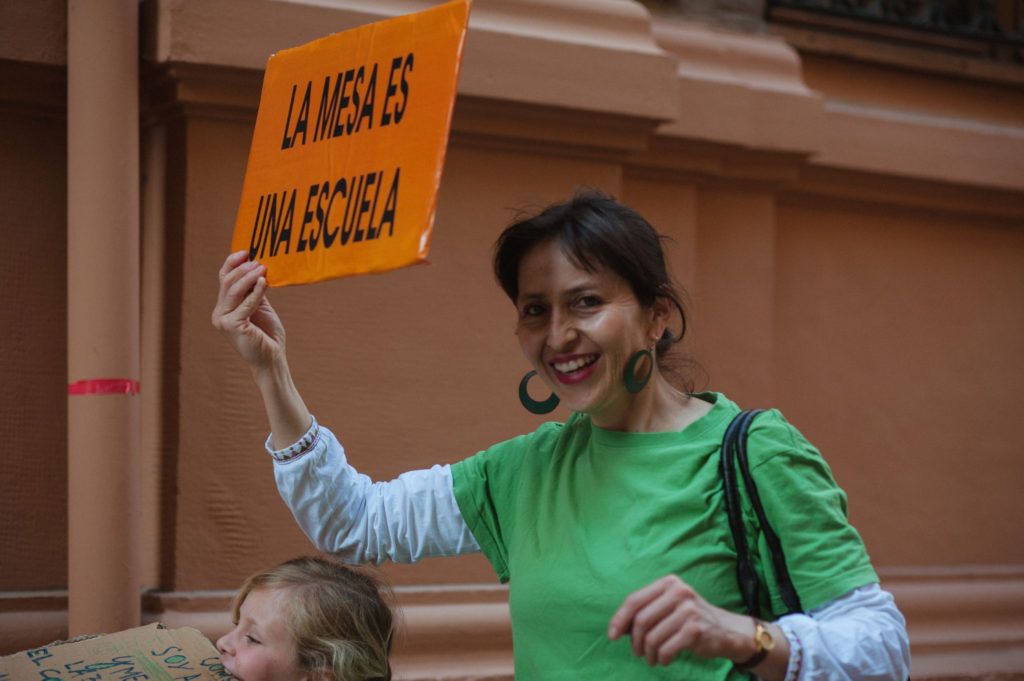
...our entire previous proposal, and the orthodox Left’s previous proposal up to then, was the opposite, it was: from above things are solved for below [...] this below-for-above change meant not organizing ourselves [...or...] other people to go vote, nor to go to a march […] to shout [...] but to survive and turn resistance into a school (emphasis added).

Zapatismo, born out of turning resistance into a school, transforms the entire process of oppositional learning and knowledge-making into a site for practising a new kind of revolutionary pedagogy, where the teachers themselves are taught. The actual process on the ground, however, followed a different path. The first indigenous members of the EZLN (Ejército Zapatista de Liberación Nacional, the Zapatista Army of National Liberation) were recruited way back in 1978-80 by the “urbanite” guerrillas who had succeeded in setting up a safe house in San Cristóbal de las Casas with the help of the indigenous people (Oikonomakis 2019). The EZLN safe houses were also schools where young indigenous recruits were taught how to read and write as well as being educated in Marxism, other typical subjects, weapon use and survival skills (Cedillo 2010; DeLa Grange/Rico 1999, quoted in Oikomomakis 2019). Once their training was complete, the students would return to their villages to become “instructors” for the next batch of newly recruited students. The EZLN still uses the same system of self-instruction in its own autonomous territories (Oikonomakis 2019). Looking at the history of the EZLN and the Zapatista revolution, we wonder how much of the new oppositional knowledge of “commanding by obeying” can be traced back to older, orthodox forms of leftist pedagogy and organising, whereby students had to be recruited and taught to prepare them for roles as militants/soldiers of the impending revolution. Though the Lacandon jungle in Mexico has witnessed many revolts, uprisings and organised denials of the Mexican state(Oikonomakis 2019; Khasnabish 2010), it cannot be considered a pre-determined, historical given that Zapatismo, with its essential philosophical otherness based on a process of learning to listen, obey and serve(Dussel 1998, quoted in Paradiso-Michau 2008), would have evolved as it did without the long and heroic efforts of the members of the hierarchical and vanguardist Marxist-Leninist party Fuerzas de Liberación  Nacional(FLN, Forces of National Liberation). The Zapatistas and the EZLN no longer talk about their FLN past (apart from remembering the martyrs), but it is a fact that the EZLN was first conceived as the rural wing of FLN in 1980(FLN 2003, quoted in Oikonomakis 2019). FLN, most likely an offshoot of a still-earlier revolutionary process called Ejército Insurgente Mexicano (EIM, Mexican Insurgent Army), was formed in 1969, and its attempts to penetrate the Lacandon jungle probably began in 1972. When, in 1993, the indigenous leaders in the Comité Clandestino Revolucionario Indígena (CCRI, Indigenous Clandestine Revolutionary Committee) and the EZLN had already decided to go to war, FLN’s leadership had to be persuaded of the desirability of the proposed course of action (Cedillo 2010; DeLa Grange/Rico 1999, quoted in Oikonomakis 2019). After a discussion that continued for several days, it was decided that from then onwards, the CCRI — in other words the EZLN’s indigenous leaders —and not the “politico-military organisation” of FLN would assume leadership of the Zapatista revolution (Le Bot/Marcos 1997, quoted in Oikonomakis 2019).

The above account proves that in the terrain of oppositional politics, neither organisational forms nor “political beliefs” are static and nothing is sacrosanct besides oppositionality. This is because both the organisational form of a movement and the convictions of its militants respond to the movement’s actuality: they have to remain fluid; otherwise, no revolutionary praxis is possible. Fluidity ensures that the learnt is constantly unlearnt and re-learnt: ideas appear, disappear and reappear. The vanguardist hierarchy of a Marxist-Leninist party can take an informed decision to dissolve itself in a from-the-below indigenous-led revolution that aims not to seize state power but to establish autonomous municipalities and territories in opposition to the capitalist nation-state and its from-the-above “geographies” (Marcos 2018). Once again, the Zapatista call for autonomy and horizontality does not stem from any anarchist concept relying on spontaneity rather than organisation. Instead, it is backed up and put into practice by a well-structured organisational network and a revolutionary army that came into being through the arduous work of generations of political workers belonging to a traditional leftist party. It is surely not a coincidence that the municipalist revolution in Rojava by the stateless Kurds, led predominantly by women, was also initiated by what was originally an orthodox Marxist-Leninist formation and is also supported by an armed militia. It is doubtful how long the autonomous cantons at Rojava and the Zapatistas’ territories could survive systematic military aggression by the capitalist nation-states that surround them were full-blown conflicts to break out, but that is a different question altogether. Besides, it is possible that all processes of oppositional politics have to face similar challenges, because the state can respond in devious ways. The art of engaging, dealing with and resisting the state forms part of the oppositional knowledge that makes revolutionary praxis possible. Movements and their militants do not acquire this knowledge through mere participation in organisations, events and un-organisational horizontality. Rather, the knowledge is born of, and is part of, the political continuities formed by the past, present and future in equal proportions: the past because revolutionary processes and ideas from the past, more than the historical evolution of production systems, inform all present oppositional processes; the present because that is where praxis unfolds, erupts and create ruptures; and the future because the emancipation of the working class and the human species, e.g. communism, is part of that future. All social movements with a political dimension must consciously and collectively situate —as well as discover — themselves in those continuities.

Conclusion: understanding and deepening oppositionality

To situate and discover themselves within fluid political continuities, movements must internationalise opposition. Without internationalisation, the horizontal grassroots of the local and the autonomy they profess to represent would probably shrivel in double quick time. Revolutions would appear and disappear, insurrections would be suppressed or co-optated, riots would succeed riots, and yet the immanence would remain unrealised: the perennial spring of freedom would never be ours.

When we talk about internationalising, we do not mean building a new revolutionary International. Internationalisation, as we see it, would require each association, assembly, union, organisation or party to acquire collective criticality. That is, each movement practice must learn to see beyond the hegemony of the capitalist real and revisit its theories, strategies and actions with relentless criticality, which cannot be compromised for the sake of organisational and other compulsions, such as state repression and the necessity of “positive” engagements with the state. Suspending criticality might help in immediate mobilising, but seriously harm the collective’s cognitive ability to grasp the oppositional not only within the society but also within the apparently autonomous spaces created by the movement collectives. As long as movement collectives are forced to exist in spatially and organisationally separate enclaves within a dominant capitalist real, any victories can only be ephemeral.

The movements of perpetual oppositionality have to transcend themselves. This transcendence is both social and political: social because the movements remake the social relations of power firstly by remaining alive and secondly through conscious oppositionality; political because the process is neither conceivable nor actualised without constant analysis, critique and confrontation of the state. Thus the transition from the particularity of an insurrection to the philosophy of a revolution, from the tumultuous moment of the evental to the eternity of the revolutionary horizon and the reclaiming of the individual, “free-active” subject: movements that organise for the present and not a future that is and isn’t part of that present fail to posit emancipatory politics. Since the working class constitutes itself as an oppositional force only through its collective political will to oppose (Gramsci 2001, quoted in Galastri 2018; Galastri 2018; Thompson 2013), whosoever revolts against the State-Capital tyranny and fights for a non-state, non-capital world is part of the proletariat (Balibar 1977, 1994). And only the proletariat can keep the rebellion going (Marx/Engels 1976; Dean 2016).

All movements and movement organisations, if they are oppositional, are part of greater political continuities that transcend space-time. We can even re-imagine a new kind of party that acts purely as a facilitator, an organiser entity, that senses the immanence but does not usurp its vanguardist agency as a higher body (Beaudet 2016; Dean 2012). It remains true to the idea of communism and communist revolution, but does not lead it by commanding. Conversely, it learns to command by obeying, as the Zapatistas do. Like the Chinese Communist Party in the pre-revolutionary China, it practises a mass line and learns from the mass, which it helps to come into being by spatially and politically linking various strands of non-state oppositionality, insurrectionary and otherwise (Hui 2016a, 2016b), existing within the capitalist real. It ensures that the oppositional knowledge of the non-state, non-capital informs the movements that unfold and erupt within the present enclosed by the State-Capital; even if the insurrections end not in a bang but pathetic whimper of social democracy, it sees the rupture latent in the event and champions the transcendence that is no longer visible. Anything is possible as long as oppositionality does not die.

Soumitra Ghosh, a social activist and independent researcher, has been working with forest communities in sub-Himalayan West Bengal in India for several decades. He has written extensively on issues related to the politics of struggles for forest Commons as well as climate justice and climate change, particularly its political economy.


Bibliography

Alcázar, M. M. (2019). The Weakest Link, in: New Left Review (2019). The New American Left, a compendium of five statements/articles in New Left Review (116/117).

Aranda, D. (2016). Argentine Social Movements Strike Back Against Monsanto, in: Upside Down World. Available at:http://upsidedownworld.org/main/argentina-archives-32/5558-argentine-social-movements-strike-back-against-monsanto.

Badiou, A. (2010a). The Communist Hypothesis. London, Verso.

Badiou, A. (2010b). The Idea of Communism 1, in: Žižek, S./Douzinas, C. (eds). The Idea of Communism. London, Verso.

Badiou, A. (2012). The Rebirth of History. London, Verso.

Balibar, E. (1977) (2011): On the Dictatorship of the Proletariat.London, Verso.

Balibar, E. (1994). Masses, Classes and Ideas.New York,Routledge.

Balso, J (2010): To Present Oneself to the Present. The Communist Hypothesis: a possible Hypothesis for Philosophy, an Impossible Name for Politics? In Zizek. S & Costas Douzinas(ed): The Idea of Communism 1, London, Verso. 

Beaudet, P. (2016). In Search of the “Modern Prince”: The New Quebec Rebellion, in: Panitch. L./Albo, G. (eds). Rethinking Revolution: Socialist Register 2017. London, Merlin Books.

Barker, C.et al. (2013). Introduction: Marxism and Social Movements, in: Barker, C. et al. (eds): Marxism and Social Movements. Leiden, Brill.

Barker, C. (2013). Class Struggle and Social Movements in Marxism and Social Movements,

in: Barker, C. et al. (eds), op. cit.

Becker, M. (2015). Ecuador’s New Indigenous Uprising, in: Upside Down World. Available at: http://upsidedownworld.org/main/ecuador-archives-49/5422-ecuadors-new-indigenous-uprising.

Bray, M. (2013).Translating Anarchy: The Anarchism of Occupy Wall Street, Zero Books. Winchester. 

Bridle, J. (2018). New Dark Age. London, Verso.

Bookchin, M. (2015). The Next Revolution. London, Verso.

Bosteels, B. (2014). The Actuality of Communism. London, Verso.

Buck-Morss, S. (2013): A Commo(u) nist Ethic, in in Zizek. S. (ed): The Idea of Communism 2. London, Verso.

Caffentzis, G./Federici, S. (2014). Commons Against and Beyond Capitalism, in: Community Development Journal 49(51), January 2014.

Cedillo, A. (2010): El Fuego y el Silencio. Historia de las Fuerzas de Liberación Nacional a la Fundación del Ejército Zapatista de Liberación Nacional, quoted in: Oikonomakis(2019). Political Strategies and Social Movements in Latin America. Cham (Switzerland), Palgrave Macmillan.

Chaohua, W. (2015). The Party and its Success Story, in: New Left Review 31, January-February 2015.

Chomsky, N. (2012). Occupy, Zuccotti Park Press. Brooklyn 

Ciccariello-Maher, G. (2016a). Venezuela: ¡Comuna O Nada!, in: Roar Magazine: 1(1). Available at: https://roarmag.org/magazine/venezuela-communa-o-nada/.

Ciccariello-Maher, G. (2016b). Building the Commune: Radical Democracy in Venezuela. London, Verso.

Clover, J. (2016). Riot, Strike, Riot: The New Era of Uprisings. London, Verso.

Dangl, B. (2007): The Price of Fire: Resource Wars and Social Movements in Bolivia. Oakland, AK Press.

Dangl, B. (2010). Dancing with Dynamite: Social Movements and State Power. Oakland, AK Press.

Dean, J. (2012). The Communist Horizon. London, Verso.

Dean, J. (2013). The Communist Desire, in: Žižek, S.(ed.).The Idea of Communism 2.London, Verso.

Dean, J. (2016). Crowds and Party. London, Verso.

DeLa Grange, B./Rico, M. (1999): El Otro Subcomandante: Entrevista Con Salvador Morales Garibay, in: Letras Libres, quoted in: Oikonomakis (2019), op. cit.

Dirik, D. (2016). Building Democracy without the State, in: Roar Magazine 1(1). Available at: https://roarmag.org/magazine/building-democracy-without-a-state/.

Dussel, E. (1998): Twenty Theses on Politics, trans. George Ciccariello-Maher and Eduardo Mandieta. Durham(NC, US), Duke University Press, quoted in: Paradiso-Michau, M. R. (2008). The Widow, the Orphan, and the Stranger: Levinasian Themes in Dussel’s Political Theory, in: Radical Philosophy Review 11(2).

Fassin, D./Defossez, A. (2019). An Improbable Movement? Macron’s France and the Rise of the Gilets Jaunes, in: New Left Review 115, Jan-Feb 2019.

Fiorentini, F. (2012). Remembering the Social Movements that Re-imagined Argentina, in: Upside Down World. Available at:http://upsidedownworld.org/main/argentina-archives-32/3411-remembering-the-social-movements-that-reimagined-argentina-2002-2012.

Foster, J. B. (2015). Chávez and the Communal State, in: Monthly Review 66(11), April 2015.

FLN (2003). Statutes of the Forces of National Liberation, Abraham Guilien Press, quoted in: Oikonomais (2019), op. cit.

Gahmann, L. (2016): Dismantling Neoliberal Education: A Lesson from the Zapatistas, in: Roar Magazine. Available at:https://roarmag.org/essays/neoliberal-education-zapatista-pedagogy/

García Linera, A. (2006). State Crisis and Popular Power, in: New Left Review 37.

García Linera, A. (2008). La Potencia Plebeya, quoted in: Bosteels, B., op. cit.

Gerbaudo, P. (2016): Nuit Debout: Building an Open Movement in France’s Squares, in: Roar Magazine. Available at:https://roarmag.org/essays/nuit-debout-interview-baki-youssouf/(22 June 2016).

Goanec, M. (2019). Gilets Jaunes Gather for Third “Assembly of Assemblies”, in: Roar Magazine. Available at:https://roarmag.org/essays/gilets-jaunes-third-assembly-assemblies/.

Gong, J. (2019). Voting and Class Struggle, in: New Left Review, op. cit.

Gramsci, A. (2001). Quaderni del carcere: edizione critica dell’Istituto Gramsci, vol 4. Turin, Giulio Einaudi, quoted in: Galastri, L. (2018). Social Classes and Subaltern Groups: Theoretical Distinction and Political Application, in: Capital and Class 42(1).

Harding, J. (2016). Apartheid’s Last Stand, in: London Review of Books 38(6).

Harding, J. (2018). Don’t Pretend You Can’t See Us, in: LRB Blog, 30 November 2018. Available at:https://www.lrb.co.uk/blog/2018/november/dont-pretend-you-cant-see-us.

Harding, J. (2019). Among the Gilets Jaunes, in: London Review of Books 41(6), 21 March 2019.

Hardt, M./Negri, A. (2005). Multitude. London, Hamish Hamilton.

Hardt, M. (2010). The Common in Communism, in: Žižek, S./Douzinas, C. (eds): The Idea of Communism 1. London, Verso.

Herrera, L. (2014). Revolution in the Age of Social Media: The Egyptian Popular Insurrection and the Internet, London. Verso.   

Hesketh, C. (2013). Defending Place, Remaking Space: Social Movements in Oaxaca and Chiapas, in: Barker, C. et al. (eds), op. cit.

Holloway, J. (2002) (2005). Change the World Without Taking Power. London, Pluto Press.

Holloway, J. (2010). Crack Capitalism. London, Pluto Press.

Holloway, J. (2015). No, No, No, in: Roar Magazine, Issue 0. Available at:roarmag.org/magazine/john-holloway-no-no-no/.

Hui, W. (2009). The End of Revolution. London, Verso.

Hui, W. (2016a). The “People’s War” and the Legacy of the Chinese Revolution, in: Panitch, L./Albo, G. (eds). Rethinking Revolution: Socialist Register 2017. London, Merlin Books.

Hui, W. (2016b). The Crisis of Representativeness and Post-Party Politics, in: Taek-Gwang Lee, A./Žižek, S. (eds). The Idea of Communism 3: The Seoul Conference. London, Verso.

Iglesias, P. (2015). Understanding Podemos, in: New Left Review 93, May-June 2015.

Jameson. F (2015): The Aesthetics of Singularity, in New Left Review, 92, March-April 2015.

Jay, S. (2016). The Postmodern Left and the Success of Neoliberalism. Available at:http://libcom.org/library/postmodern-left-success-neoliberalism.

Khasnabish, A. (2010). Zapatistas: Rebellion from the Grassroots to the Global. Halifax, Fernwood Publishing and London, Zed Books.

Krinsky, J. (2013): Marxism and the Politics of Possibility: Beyond Academic Boundaries, in: Barker, C.et al. (eds), op. cit.

Kouvelakis, S. (2016). Syriza’s Rise and Fall, in: New Left Review 97, January-February 2016.

Kouvelakis, S. (2019). The French Insurgency, in: New Left Review 116/117, March-June 2019

Le Bot, Y./Subcommander Marcos(1997). El Sueño Zapatista. San Cristóbal de Las Casas (Chiapas, Mexico), quoted in: Oikonomakis (2019), op. cit.

Lebowitz, M. (2012). The Contradictions of “Real Socialism”. New York, Monthly Review Press.

Lenin, V.I. (1917). The State and Revolution. Available at:https://www.marxists.org/archive/lenin/works/1917/staterev/index.htm.

Leverink, J. (2015). Murray Bookchin and the Kurdish Resistance. Available at:https://roarmag.org/essays/bookchin-kurdish-struggle-ocalan-rojava.

Levi, P. (2011). In the Steps of Rosa Luxemburg. Leiden, Brill.

Luxemburg, R. (1918). The Russian Revolution. Available at:https://www.marxists.org/archive/luxemburg/1918/russian-revolution/index.htm.

—- (1904): Organizational Questions of the Russian Social Democracy [Leninism or Marxism?], Available at: https://www.marxists.org/archive/luxemburg/1904/questions-rsd/index.htm

Mao, Z.(1974). Mao Tse-tung Unrehearsed. London, Penguin Books.

Marcos(2018): The Zapatistas’ Dignified Rage: Final Public Speeches of Subcommander Marcos, edited by Henck, N.Edinburgh, AK Press.

Marx, K. (1844).Economic and Philosophic Manuscripts. Available at:https://www.marxists.org/archive/marx/works/1844/manuscripts/preface.htm.

Marx, K. (1847).The Poverty of Philosophy. Available at:https://www.marxists.org/archive/marx/works/1847/poverty-philosophy/index.htm.

Marx, K. (1869). The Eighteenth Brumaire of Louis Bonaparte, in: Marx, K./Engels, F. (1962). Selected Writings. Moscow, Progress Publishers.

Marx, K. (1871). Letter from Marx to Friedrich Bolte, written on 23 November 1871.Available at:https://www.marxists.org/archive/marx/works/1871/letters/71_11_23.htm.

Marx, K. (1891), Civil War in France, in: Marx, K./Engels, F., op. cit.

Marx, K. (1895). Class Struggles in France, in: Marx, K./Engels, F., op. cit.

Marx, K./Engels, F. (1976). The German Ideology. Moscow, Progress Publishers.

Mason, S. (2019). Challenging Capital, in: New Left Review, op. cit.

Mészáros, I. (1970). Marx’s Theory of Alienation. London, Merlin Press.

Mészáros, I. (1995): Beyond Capital: Towards a Theory of Transition. London, Merlin Press.

Mészáros, I. (2015). The Necessity of Social Control. New York, Monthly Review Press.

Mills, F.B. (2015). Chavista Theory of Transition Towards the Communal State, in: Open Democracy, 8 August 2015. Available at: https://www.opendemocracy.net/frederick-b-mills/chavista-theory-of-transition-towards-communal-state.

Modonesi, M. (2015). The End of Progressive Hegemony and the Regressive Turn in Latin America: The End of a Cycle?, in: Viewpoint Magazine, 21 December 2015. Available at: https://viewpointmag.com/2015/12/21/the-end-of-progressive-hegemony-and-the-regressive-turn-in-latin-america-the-end-of-a-cycle/.

Moya, R. C. (2019). Risks of Co-option, in: New Left Review, op. cit.

Negri, A. (2010). Communism: Some Thoughts on the Concept and Practice, in: Žižek, S./Douzinas, C. (eds). The Idea of Communism 1. London, Verso.

Nilson, A. G./Cox, L. (2013). What Would a Marxist Theory of Social Movements Look Like?, in:

Barker, C. et al. (eds), op. cit.

Oikonomakis, L. (2015). Why We Still Love the Zapatistas, in: Roar Magazine, Issue 0: Available at: https://roarmag.org/magazine/why-we-still-love-the-zapatistas/(22 June 2016).

Oikonomakis, L. (2019). Political Strategies and Social Movements in Latin America. Cham (Switzerland), Palgrave Macmillan.

Petras, J./Veltmeyer,H. (2005). Social Movements and State Power. London, Pluto Press.

Sallai, A. (2019). Towards a Socialist Party, in: New Left Review, op. cit.

Sitrin, M. (2012). Everyday Revolutions: Horizontalism and Autonomy in Argentina. London, Zed Books.

Sitrin, M. (2016): “Soon We Will Be Millions”: From Paris with Love and Lessons, in: Roar Magazine. Available at: https://roarmag.org/essays/from-paris-with-love-and-lessons/.

Sitrin, M./Azzellini, D. (2014). They Can’t Represent Us: Reinventing Democracy from Greece to Occupy. London, Verso.

Sotiris, P. (2015). Rethinking Revolutionary Strategy Today (extended notes for a presentation at the 12thHistorical Materialism Conference, London, 5-8 November 2015). Available at:https://www.academia.edu/18154977/Rethinking_Revolutionary_Strategy_Today.

Sourice, B. (2016). Nuit Debout: A Convergence of Struggles Takes Shape in France, in: Roar Magazine. Available at:https://roarmag.org/essays/paris-square-occupation-nuitdebout/(22June 2016).

Stedile, J. P. (2002). Landless Battalions: the Sem Terra Movement of Brazil, in: New Left Review 15(3).

Taylor, A. et al. (eds) (2011). Occupy: Scenes From Occupied America. London, Verso.

Thompson, E. P. (2013). The Making of the English Working Class. London, Pelican.

Tufekci. Z. (2017). Twitter and Tear Gas: The Power and Fragility of Networked Protests. New Haven, Yale University Press.

Voloshinov, V.N. (1973). Marxism and The Philosophy of Language, New York/London. Seminar Press 

Webber, J. (2011). Red October: Left-Indigenous Struggles in Modern Bolivia. Leiden, Brill.

Webber, J. (2015). Burdens of a State Manager, in: Viewpoint Magazine, 25 February 2015. Available at: https://viewpointmag.com/2015/02/25/burdens-of-a-state-manager/.

White, M. (2016): The End of Protests:a New Playbook for Revolution. Toronto, Knopf Canada.

White, M. (2017). Occupy and Black Lives Matter Failed, in: The Guardian, 28 August 2017.

Zibechi, R. (2010). Dispersing Power: Social Movements as Anti-State Forces. Oakland/Edinburgh, AK Press.

Zibechi, R. (2014). Latin America Today: Seen from Below, an interview with Raúl Zibechi, in: Upside Down World. Available at: http://upsidedownworld.org/main/international-archives-60/4907-raul-zibechi-latin-america-today-seen-from-below(11 January 2016).

Zibechi, R. (2015). Ecuador: The “Citizens’ Revolution” vs Social Movements, in: Upside Down World. Available at: http://upsidedownworld.org/main/ecuador-archives-49/5189-ecuador-the-citizens-revolution-vs-social-movements(22 June 2016).

Zorilla, C. (2015). Ecuador: Widespread Protests From Left and Indigenous Sectors, in: Upside Down World. Available at: http://upsidedownworld.org/main/ecuador-archives-49/5436-ecuador-widespread-protests-from-left-and-indigenous-sectors-demand-progressive-changes(22 June 2016).

Zurbrugg, A W. (2016). 1917 and the ‘workers’ state: looking back in —-(2016b): The Actuality of Revolution in Panitch. L & Albo. G(ed): Rethinking Revolution: Socialist Register 2017, Merlin Books, London


Endnotes

[i]The gilets jaunes staged their 49th Act on 22 October 2019, roughly two weeks before the movement’s first anniversary. See https://www.connexionfrance.com/French-news/Giletss-jaunes-Acte-49-protest-marches-honour-France-s-striking-firefighters

[ii]https://resistance71.wordpress.com/2019/04/10/english-translation-of-the-yellow-vests-call-after-the-second-assembly-of-assemblies-in-st-nazaire-april-5-7-2019/

[iii]See the homepage of Occupy: http://occupywallst.org/.

[iv] In a Zapatista programme in 2014, Marcos died as Marcos and was reborn as Galeano, another of the martyrs of the revolution. See Nick Henck(2018): Introduction to The  Zapatistas’ Dignified Rage.

[v]Subcommander Marcos’s Words for the National and International Caravan for Observation and Solidarity with Zapatista Communities, La GarruchaCaracol, 2 August 2008. Emphasis added)


by Larry Lohmann

One impressive thing about the new climate movements Fridays for Future (FFF) and Extinction Rebellion (XR) is that they do try to take the warnings of climatology seriously. Not only more seriously than ruling elites, but also, arguably, more seriously than the older generation of climate activists associated with the likes of Environmental Defense Fund, WWF, Greenpeace and the Climate Action Network.

Such organizations wasted two decades pushing climate policies that they imagined capitalist elites might accept (carbon pricing, energy “transition” schemes involving accelerated extractivism, and so on). From early on, it was evident that these policies could have no climate benefits whatever. Equally, they tended to alienate many of the grassroots movements most needed for a more powerful global climate alliance. Trapped by orthodox economic thinking, mainstream environmental organizations from the global North had failed to develop either their analysis or their organizing.

So campaigns like FFF and XR look to be embarking on a welcome return toward fundamentals. Nevertheless, they continue to be constrained – in a quite understandable way – by certain misunderstandings of what the climate crisis is and what is needed to mobilize politically around it. Ironically, this has come about partly as a result of the unexamined relationships that such movements maintain with the very climate and energy sciences that they rightly take so seriously.

There may be no way of putting this gently. The issue is not that movements like XR and FFF, like their more mainstream predecessors, tend to be largely white in their constitution, history and culture. That is something that they are obviously aware of and already struggling within their efforts to reach out and join themselves to broader-based climate movements.

The bigger challenge is what such movements plan to do about the fact that the main concepts that they work with at present – climate and energy, for example – are also white. And not only white, but also gendered and class-biased.

Here it may be necessary to pause for a moment. Decades of scholarly work notwithstanding (e.g., Smith and Wise 1989, Caffentzis 2013, Edwards 2013, Taylor 2015, Lohmann forthcoming), the idea that such concepts might be white still shocks many Western intellectuals.

Faces might be white; cultures might be white – but what could it mean, many white climate activists wonder, to say that today’s dominant concepts of climate and energy are also white? Surely those greenhouse gas molecules migrating across the border of a “climate system” computed by Global Circulation Models are colourless, no? And how could energy be anything but a universal, nonracial, genderless substance craved by generic humans from time immemorial – even if it did happen to originate in the ways 19th-century patriarchies and empires organized the mass interconvertibility of motion, heat and electricity, together with the resulting waste, across broad peasant, Indigenous and urban territories in the service of industrial exploitation (Hildyard and Lohmann 2014, Daggett 2019)?

Yet as the news about structural racism filters slowly toward the mainstream amid daily bulletins about algorithmic bias, worldwide George Floyd uprisings, and Covid-19 mortality patterns transparently shaped by centuries of white supremacy, now may be a good time to put in a bit of work to try to understand better the racial, patriarachal constitution of the climate and energy concepts that climate movements have inherited.

The Jamaican analytic philosopher Charles W. Mills (1998) writes of the “wonder and complaint” that his field provokes among minorities: not so much because so many academic philosophers have white faces, but because the subject matter itself is white. And more importantly, because so many white philosophers have a hard time even “seeing” the biases that their theoretical canon perpetuates (Eze 1994, Oyewumi 1997), or perceiving the prejudices implicit in the field’s habitual “reliance on
idealization to the exclusion, or at least marginalization, of the actual” (Mills 2005: 168). Feminists know this as the “just add women and stir” approach. Because the philosophical canon is imagined to be unraced and ungendered, any concerns about patriarchy – or white supremacy – are supposed to be addressable just by getting more women – or Blacks – to recognize and contribute to it.

Is it too provocative to apply these lessons to climatology as well? Last April, a spokesman for XR America told his colleagues that we “don’t have time to argue about social justice … If we don’t solve climate change, Black lives don’t matter” (Dembicki 2020). Other leftist white activists and academics from both the US and Europe chimed in that Black Lives Matter, #metoo and other movements, important as they were, were in the end just playing around with “identity politics,” whereas the climate crisis required a more “universalizing” stance to organize a “unified, powerful, effective and sustained” movement capable of “getting past our differences” and “transforming the socio-ecological relations in which we live.” In the background, Bill McKibben continued to insist that in understanding the need for climate action, “350 is the most important number in the world” – apparently more important than, say, the number of humans and nonhumans sacrificed over the years for fossil fuel extraction and pollution or the number of nations subjected to imperial rule for the sake of cheaplymechanized labour (Malm 2016).

Not every climate activist in the global North may be aware of the extent to which such discourses are the object of lampoon and ridicule among climate movements in the global South. Which is why it might be worth spending some time exploring the deeper, climatological roots of what they often find problematic.

In 2014, Sir John Houghton, founding member of the Intergovernmental Panel on Climate Change, gave an interview explaining that UN climatologists were not permitted to mention the carbon locked up in fossil fuels in their analysis of climate change, but only carbon that had become more mobile in the form of CO2 (Marshall 2014). To follow what happens when carbon atoms cross one of the internal borders of the earth’s geophysical system into the atmosphere is “science,” Houghton said. But to analyze their movements toward that border “is not a science question.” In other words, climatology is not allowed to ask why the climate is changing any more than a Donald Trump appointee is allowed to ask why Guatemalan slum dwellers might be compelled to jump on the train known as La Bestia in an attempt to reach the US border.

The consequence of this scientific methodology is to treat the climate crisis in more or less the same way that the far right treats immigration. If the problem is too many immigrant molecules of a certain kind, then any solution must naturally start with controlling immigrant numbers at the border.

This might help suggest why a Guatemalan climate activist, say, might find herself somewhat bemused by a white US climate activist’s earnest advocacy of carbon prices, carbon-neutral development, carbon-zero renewables, carbon-restrictive Green New Deals, carbon-centred Natural Climate Solutions or any other approach that hierarchically identifies the primary problem as immigrant carbon dioxide molecules rather than historically-rooted patterns of capital accumulation, white supremacy, unrelenting imperialism and ruthless patriarchy. Or that sees climate justice as a matter of starting with carbon controls (never mind what authority might be appointed to do the controlling) and then “stirring in” some green jobs or a bit of equitable energy distribution, without considering what that energy actually consists in.

Does that mean that Northern climate activists should reject, refuse or try to flee from their concepts of climate and energy? Not at all. That would be as fruitless as white anti-racist activists trying to reject, refuse or flee from their own whiteness (Sullivan 2014, Alcoff 2015). It would be to disrespect that very climatology and 19th-century energy science that networks like XR and FFF have justifiably committed themselves to taking so seriously. Because it would be to airbrush out the troubled histories of those sciences as well as to dismiss their capacity to change and become more scientific.

Instead of climate activists rejecting outright the white climate and white energy bestowed on them by their tradition, then, the point is to decide in a more self-aware fashion what kind of relationship they need to have with them, as objects in the making.

Like any relationship, that relationship is not given for all time. It is something that will always need work. As any social anthropologist knows who has ever joined discussions of climate change in places like Sierra Norte de Puebla (Smith 2007), Molo in West Timor, or the highlands of Scotland, there will always be other climates and other energies in dynamic relations with the capitalist climate and energy that up to now have dominated the world view of most Northern climate agitators. Helping to bring these practices into a less hierarchical dialogue with one another might be a first step toward building global climate movements that are stronger than those the past twenty years have witnessed.


Larry Lohmann The Corner House, Sturminster Newton UK.


References

Alcoff, L. R. 2015. The future of whiteness. Cambridge: Polity Press.

Caffentzis, G. 2013. In letters of blood and fire: work, machines and the crisis of capitalism. Oakland: PM Press.

Daggett, C. N. 2019. The birth of energy: fossil fuels, thermodynamics and the politics of work. Durham: Duke University Press.

Dembicki, G. 2020. ‘A debate over racism has split one of the world’s most famous climate groups’, Vice, 28 April, https://www.vice.com/en_us/article/jgey8k/a-debate-over-racism-has-split-one-of-the-worlds-most-famous-climate-groups.

Edwards, P. 2013. A vast machine: computer models, climate data, and the politics of global warming. Cambridge, MA: MIT Press.

Eze, E. 1994. The Color of Reason: The Idea of ‘Race’ in Kant’s Anthropology, in K. M. Faull (ed.), Anthropology and the German Enlightenment: perspectives on humanity, 200-241. London: Bucknell and Associated University Press.

Lohmann, L. forthcoming. Bioenergy, Thermodynamics and Inequalities, in M. Backhouse and C. Rodriguez (eds.), Bioeconomy and global inequalities: knowledge, land, labor, biomass, energy, and politics. New York: Palgrave Macmillan, http://www.thecornerhouse.org.uk/resource/bioenergy thermodynamics-and-inequalities.

Lohmann, L. and N. Hildyard. 2014. Energy, work and finance. Sturminster Newton: The Corner House, http://www.thecornerhouse.org.uk/resource/energy-work-and-finance.

Malm, A. 2016, Fossil capital: the rise of steam power and the roots of global warming. London: Verso.

Marshall, G. 2014. Don’t even think about it: why our brains are wired to ignore climate change. New York: Bloomsbury.

Mills, C. W. 1998. Blackness visible: essays on philosophy and race. Ithaca, NY: Cornell University Press.

————– 2005. ‘“Ideal Theory” as Ideology’. Hypatia 20 (3): 165-184.

Oyewumi. O. 1998. The invention of women: making an African sense of Western gender discourses. Minneapolis: University of Minnesota Press.


Smith, A. D. 2007. Presence of Mind as Working Climate Change Knowledge: a Totonac Cosmopolitics, in M. Pettenger (ed.), The social construction of climate change: power, knowledge, norms, discourses. Aldershot: Ashgate, 217-34.

Smith, C. and M. N. Wise 1989. Energy and empire: a biographical study of Lord Kelvin. Cambridge: Cambridge University Press.

Sullivan, S. 2014. Good white people: the problem with middle-class white anti-racism. Albany: State University of New York Press.


Taylor, M. 2015. The political ecology of climate change adaptation: livelihoods, agrarian change and the conflicts of development. New York: Routledge.

The white gaze permeates many aspects of even the most critical disciplines. In this piece, we offer some thoughts on how we might reclaim what the university could be  – a place that equips people with the knowledge they need to unlearn/unmake/dismantle the framings and worldviews that lend themselves to white supremacy and other forms of oppression more broadly. 

by Collective of critical geography and development scholars*

Around the world, people are coming out to denounce systemic racism in their institutions and in society more broadly. The Covid-19 pandemic has offered a magnifying lens to the deep-rooted inequalities and injustices prevalent in society. It has also shown how inequalities, such as those along racial, gender, and class lines, are reinforced and compounded in a relatively short time span in the efforts to return to “normal”. Returning to business-as-usual is precisely what institutions, governments, and corporations are so desperately seeking. Yet, the world before and during the pandemic was/is premised on white supremacy, colonial legacies of natural resource extraction and bondage of cheap labour. Consequently, returning to “normal” is not something that we should ethically and politically aspire for. As Indian writer Arundhati Roy writes, the pandemic should be a “portal” to deconstruct, and transform the world that we knew before. This does not mean making business-as-usual more comprehensive, holistic, or inclusive. Rather, it involves the harder work of “un-learning” and “un-doing” the current model of productivist and extractivist development disguised as modernity and “progress”. By prioritizing careful attention and consideration of multiple ways of knowing and relating to the world, we can be better positioned to support ongoing struggles in re-building a world premised upon justice above all else.

The Responsibility of Universities and other institutions of higher learning

Universities and institutions of higher-learning have an important responsibility in these “unlearning” and “rebuilding” processes as they offer privileged spaces for enhancing critical thinking in dialogue with constant societal change. Improving societies by prioritizing justice is a core task of universities in the advancement of science and technology as collective commons. After all, what good is generating knowledge if it cannot be (re)produced, accessed, and understood by all? Even if scholars have advanced many long and fruitful discussions on how to break free from colonial legacies and extractive development models, these initiatives risk losing their meaning if they are inscribed into an academic environment which is both principled and conditioned upon competition and a growth-oriented knowledge economy. Much of the wealth of academic insights get sucked into the aspirations of an expansionary university in competition within a globalized academic industry. This hollowing-out takes place due to the ways by which the process of generating knowledge (including the labour of researchers and their collaborators) gets parameterized and packaged into predetermined “outputs” as stipulated in grant proposals and departmental performance rubrics. These quantified metrics are then used to justify academic positions (and indeed whole departments). The pressure to aspire for growth within academia risks knowledge getting detached from its situated context, losing its meaning, and instead becoming an end-product in itself.

Princeton University (Credits: Creative Commons, https://bit.ly/31lNwcP)

Worse still, this highly uneven process generates cultures of distrust, hierarchy, competition, and fast-scholarship in the race to produce more in the least amount of time. While obviously reflecting different contexts of privilege, the underlying mechanisms and logic behind this production process is no different from the discipline of a factory floor, in which researchers extract knowledge and are themselves the subject of extraction. This hierarchy of extraction can be seen when, for example, junior scholars, themselves engaged in extracting knowledge from third parties for their own projects, may be obliged to undertake menial tasks unrelated to their own research and which serve to benefit only their superiors. In addition, knowledge production in academia is reserved to those who are the best-placed to compete in this game, which is often to the disadvantage of women, people of colour and junior researchers, and those without academic credentials (including local community members who are often the “subjects” of research with whom especially social science scholars interact with in advancing either theoretical or applied knowledge).

This factory-floor model of academic production rooted in asymmetrical power relations  replicates a singular way of shaping and understanding knowledge generation. It is premised upon optimizing knowledge products as outputs dependent upon the labour (e.g. academic faculty and support staff) and resources (e.g. grant funding, partnerships, networks, and research “subjects”) required to produce these outputs in the most efficient way. This extractive process of mobilizing labour and resources for knowledge production cannot be centred on any individual, but is situated within a cutthroat industry where peer-reviewed journal impact factors, publication numbers, successful grant applications, global partnerships, graduate programs and percentage of successful graduates and even the number of followers on twitter are all instrumentalized for the purposes of showcasing which university, which department, or which faculty member wins the ‘gold medal’ in the globalized academic Olympics. The competitive tendency here already takes extraction and instrumentalization of relationships in academic collaboration as a normalized starting point and then builds on this mode of operation as a way to gain a greater share within the knowledge economy.

The instrumentalization within academia extends beyond internal collaborations within the academia to historically colonial relations of academics and their research “subjects” in the field. The relationship between historical colonial legacies in the perpetuation of the knowledge economy is indeed a serious cause for concern. Indigenous Maori scholar Linda Tuhiwai Smith argues, for instance, that social science “research” is itself one of the “dirtiest words in the Indigenous world’s vocabulary” having been inextricably linked historically to European imperialism and colonialism in terms of how “knowledge about indigenous peoples was collected, classified, and then represented back to the West.” Bhambra and colleagues take this further by stating that “[t]he foundation of European higher education institutions in colonized territories itself became an infrastructure of empire, an institution and actor through which the totalizing logic of domination could be extended; European forms of knowledge were spread, local indigenous knowledge suppressed, and native informants trained” (p.5).

This white gaze of a singular understanding of the world then gets reproduced through the production metrics and standards imposed by the knowledge economy. Implicit extractivism in the academy operates by failing to recognize and then act upon the asymmetrical ways that knowledge extraction preys upon the precarious positions of more vulnerable scholars. As scholars in Development Studies in particular, we acknowledge how insights from the so-called “Global South” have historically served and continue to serve Northern universities and research institutes. This process of translating diverse knowledges into a singular easy-to-digest narrative is precisely how white supremacy circulates, even unconsciously, in reproducing the homogenizing and simplifying patterns that have shaped colonial development since the 15th century. The factory-house model of organizing and optimizing knowledge generation follows the tradition of resource exploitation since colonial times and as such, carries with it the white gaze of what counts (and doesn’t count) as legitimate knowledge. A white gaze extends to the built-in hierarchy of knowledge producers propagated by national research foundations, where non-academic knowledge producers and researchers from the Global South are accepted only as informants or field assistants, with an incredibly skewed scale of remuneration. Ultimately, the academy extracts wealth from marginalized communities and organizations and justifies these logics by making those not under the accepted institution marginal, invisible, underfunded and with limited access to knowledge production resources.

Academics can no longer be permitted to surf this wave of deeply extractivist practice in how knowledge is generated. Transforming the university requires not only turning the mirror upon ourselves as academics in reflecting upon our practice, but also more fundamentally in actively dismantling the knowledge economy that is structured in the constant prospection, appropriation, and standardization of intellectual labour. Decolonizing the university means collectively re-establishing “the terms upon which the university (and education more broadly) exists, the purpose of the knowledge it imparts and produces, and its pedagogical operations”. Such an effort requires fundamentally different ways of political organization in how knowledge gets generated. In other words, we academics must self-reflect at the same time as we act to transform the university and society more broadly away from systemic injustices. Academics have a notorious tendency to pensively sit back and comfortably theorize on ways to dismantle systems of inequality, even as we paradoxically benefit from those very same systems of inequality in perpetuating the knowledge economy. Consequently, our privileged capacity to self-reflect risks replicating the very structures some of us write so vehemently against, particularly in the competitive arena of instrumentalizing academic relationships for the purposes of career advancement. The professionalization of social justice critique becomes trapped within a “hall of mirrors” whereby the emancipatory potential of co-produced knowledge gets neutralized by the predatory tendencies of the academic industry in which “knowledge products” are continuously stacked as if on an endless pile.

“Decolonization” – the making of a Buzzword?

Having recognized these tendencies, the academy’s approach to responding to these challenges has been to performatively showcase universities as being “inclusive.” “Decolonization” becomes a topical buzzword for which academic pursuits can be channeled to tap into new sources of knowledge outputs for more socially-just economic growth in the knowledge economy. This new “decolonial frontier” is violently at odds with what decolonization is actually about; the frontier becomes a new way to extinguish any possibility of real transformation. As Tuck and Yang have argued, decolonization is not a metaphor; it must never be co-opted by being restricted to a checklist composed of “diversity and inclusion” statements by the university, institutionalized “codes of conduct”, or integrating “decolonial” curricula into more holistic graduate programs and the like. For Tuck and Yang, decolonization refers specifically to restoring native lands that were violently usurped in the process of settler colonialism. Elsewhere, it refers to dismantling the structures of European imaginaries that have come to shape how “development” is defined and understood.

A recent protest to demand statue of slaveowner James McGill be taken down at McGill University in Montreal, Canada. (Credits: Vijay Kolinjivadi)

If recognition exists about these structural problems so ever-present in the expansionary aims of the academic industry, why does it remain so hard to impart long-lasting change that goes beyond optics? Like broader society as a whole, the answer lies in the uneven ways that power operates to discipline those who complain or deviate from standard practice in the academic profession. For instance, speaking out about some of these concerns has disproportional implications for junior scholars, and especially women and people of colour, who risk compromising their future prospects in the academy by exposing any of its potential flaws. On a broader scale, many research participants in the generation of knowledge are not even afforded a space to enter into the academy’s walls. They remain as “missing co-authors”, perpetually denied legitimacy to change the academy from within. Rather, they are charged with being essential to the research enterprise; essentially inputs for the production of knowledge products. Moreover, it is they who must absorb the implications of these “products” that inevitably shape their own livelihood capacities and potentials.

To re-emphasize, this intervention is not targeted to the specific actions of individual scholars (though these do need to be held accountable), but is rather exposing a systemic problem. As academics ourselves, we are equally complicit, and feel that it is our duty to support any type of alternative that confronts the root-causes of extractive practices in the academy. While saying this, we also recognize that writing an intervention like this comes from a position of privilege, which would not be afforded to many others, but this is precisely why we do this. Just as remaining silent about one’s own racial privilege, while claiming to “not be a racist” is how white supremacy continues to thrive, remaining silent about one’s privilege in the academic class structure is complicity in its reproduction. Either we collectively take active steps to end these exploitative ways of doing research or we stop making performative claims that we are somehow making the university more just, inclusive, and diverse.

How do we then build counter-power to address the exploitative logics underpinning the academic endeavour and to subvert any attempt to tokenize what decolonization of academia is about? Changing current academic culture and its underlying perverse incentive structure requires us to collectively stand up against an unfair system, while taking into account that any type of fundamental change is slow, therefore placing the onus particularly on the more established scholars with more or less fixed positions to change the rules of the game. Given the privilege of established scholars, this is of course a delicate process that must be conducted with great transparency and accountability to avoid reproducing new forms of inequality. Building resistance to business-as-usual does not require reinventing the wheel. We must join with feminist scholars who unequivocally state that “cultivating space to care for ourselves, our colleagues, and our students is, in fact, a political activity when we are situated in institutions that devalue and militate against such relations and practices” (p.1239). Likewise, “slow scholarship”, which refers to transforming academic institutions from the ground-up, by actively resisting against “the culture of speed in the academy and ways of alleviating stress while improving teaching, research, and collegiality”, offers a path for fundamentally transforming the power relations of knowledge production.

Moving forward

There is an increasing wealth of resources, strategies, and alternatives that are being advanced to stimulate fundamental structural changes in how the academy operates. By no means an exhaustive list, below we identify some key examples of how to move forward. These examples are even more relevant in a context of deep uncertainty and increasing precarity as a result of the global pandemic.

  • A manifesto for “building collectives of care rather than mere departments” by unlearning the boundaries of academic discipline;
  • Developing a ‘moral economy’ of knowledge co-creation that prioritizes the process over the end outcome and encourages timeless and caring spaces of interaction for genuine creativity, collegiality, and joy to be the drivers of knowledge generation;
  • Building an “ethics of mentorship” in which established scholars cede place to the learning trajectories of junior scholars and to prioritize quality and process over quantity;
  • Re-commoning knowledge for all by rethinking publication strategies to damage the pocket books of for-profit publishers and synchronously redefining and requalifying our “production”;
  • Building meaningful, non-extractive, and care-ful partnerships and collaborations for engaged social research. This requires engaging different publics, being comfortable to refine or even reject earlier ideas, fostering safe spaces to be more vulnerable about fears and emotions in the research process, directly linking research outcomes with activism and advocacy in highly political arenas, and generally amplifying the potential impact of our scholarship rather than moving on to the next product that “counts” to administrators”;
  • Reparations and redistribution of research funding such that recognition of non-academics in general and academics of the Global South is not just symbolic. A systemic reorganization process is required within the academy to recognize the shared knowledge producing labour of all partners in the process – from cleaners within the walls of the institute to participants in research endeavours in all corners of the world and in contributing to the knowledge commons;
  • Being accountable to the responsibilities that come with privilege, for example by taking the lead in shaking up evaluation protocols and shifting how accountability and evaluation metrics are established at the university and departmental level (“good enough is the new perfect”) or by ceding place in the publication race and instead empower and embolden younger and more precarious scholars to advance this agenda in their institutes and from their own lived experiences;
  • Building counter power through Internationalist unions of intellectual workers, involving unionisation beyond the established Western trade unions which often just support the privileges of the few university employees with tenure;
  • Making the work of universities function as integrated parts in a very different social metabolism – meaning that social reproduction both of research and of the university upkeep itself becomes an integral responsibility for all those affiliated with the university. In other words, this implies that the work of maintaining the academic endeavour cannot be cost-shifted to cheaper or more precarious labour, but must be a core responsibility of those who live and breathe within the university.

*Vijay Kolinjivadi is a postdoctoral fellow at the Institute of Development Policy at the University of Antwerp.

Gert Van Hecken is Assistant Professor at the Institute of Development Policy (IOB), University of Antwerp (Belgium) and Research Associate at Nitlapán-Universidad Centroamericana (Nicaragua).

Jennifer Casolo is Research Associate at Nitlapán-Universidad Centroamericana (Nicaragua), and at the Pluriversidad Maya-Ch’orti’ (Guatemala).

Shazma Abdulla is a writer, innovator, and community organizer who focuses on social inequities, racial justice, and spatial justice. She is affiliated with the Faculty of Environmental Studies at York University in Canada.

Rut Elliot Blomqvist is a doctoral candidate at the University of Gothenburg in Sweden exploring the transdisciplinary fields of utopian studies, environmental humanities, and political ecology to not only consider the structure and meaning of environmentalist political visions but also the role of literary and cultural theory in these fields. 

**We are incredibly grateful to Frances Cleaver, Tomaso Ferrando, Frédéric Huybrechs, Nathalie Pipart, Hanne Van Cappellen, and Juan Sebastian Vélez Triana for useful comments and suggestions provided on earlier drafts.

by Ethan Earle

Almost two years after the first protests and shortly after the 2020 Bastille Day: What to make out of the Yellow Vests and the state of French democracy?

What to take away from the recently Macron-initiated citizens’ assemblies? Have the Yellow Vests and other protest shaken the French political establishment?

Initially launched as a protest against rising fuel prices, the yellow vests in France quickly turned into a popular form of protest that raises deeper issues at the heart of marginalization: democracy and economic justice. Unprecedented for its longevity and regularity, the Yellow Vests’ activities came to an abrupt end with Macron’s confinement order due to covid19. As they slowly pick up again, listen to Ethan Earle addressing a common misconception about the Yellow Vests and why the ballot box is not where their greatest mark is to be left.

by Raphael Hoetmer

Over the last two decades, various consultation practices regarding extractive activities have emerged and been implemented throughout Latin America. Some practices adopt a completely autonomous and communitarian approach, some are based on alliances between civil society and local government, while others are also increasingly centred around national governments in connection with new legislation as per international standards on indigenous peoples’ rights.

These consultation practices come from two related sources. On the one hand, the long-standing struggle for the recognition of the collective rights of indigenous peoples led to International Labour Organisation (ILO) Convention 169 on the rights of indigenous peoples (ILO C169, signed in 1993) and the United Nations Declaration on the Rights of Indigenous Peoples (2007) that established indigenous peoples’ right to prior, free and informed consent (PFIC)[1] concerning the projects and policies affecting their lives.

On the other hand, extractivism has intensified and expanded into new territories (especially those under the control of indigenous and peasant communities), provoking resistance and social conflict. Social movements’ experimentation with new political practices and the emergence of new public policies on governing these disputed territories and populations have also exacerbated the situation.[2]

In response to intense protest over the impact of extractive projects, Peru’s nationalist government, led by Ollanta Humala (2011-2016), approved a law for prior consultation (Ley de Consulta Previa) when it came to power. This law was based on ILO C169, which Peru had signed in 1993 but had never implemented. The legal framework established through discussions on the implementation of the law has served as the cornerstone of government-led consultation on the exploitation of natural resources since 2013; no new grassroots-based consultations have taken place since.

Both the practice of social-movement-driven consultations on the exploitation of natural resources and the transition to state-led consultations offer an excellent opportunity to address one of the most intense debates in the Global Working Group Beyond Development regarding what democratic processes and institutions can allow with regard to the construction of alternatives to development and colonial-patriarchal capitalism, and what role the state can or cannot play in this connection.

Credits: Author’s personal archive

In this document we will examine the following questions: to what extent could social-movement-driven consultations influence decisions on territories and economic projects? How did the state-led institutionalisation of the right to be consulted affect people’s capacity to make decisions about their territories and lives? What lessons can we learn here with regard to i) the dynamics between autonomous institutional processes and state-led processes; and ii) the potential scope of institutional processes concerning the exercise of rights and the transition beyond development?

SOME NOTES ON THE STATE

Experience of consultation on extractive activities indicates that there are two major challenges facing contemporary liberal democracies, namely: how can we juggle cultural diversity, historical discrimination and, in particular, the place of indigenous peoples in our societies? And in what ways can democracy allow decision-making on economic models and processes, more specifically with regard to the exploitation of the commons? These questions are deeply intertwined, as indigenous peoples hold tenure rights over a large part of the world´s land surface, including particularly diverse ecosystems that are crucial to the future of mankind at a time of ecological crisis.

Within this document, I will consider two different theories of the state present in social movements, left-wing politics and the intellectual debate on emancipation in Latin America, as well as within the Working Group. Both perspectives would agree that the modern state in the Americas was built upon the exclusion, exploitation and dominion of the colonial elite over the indigenous peoples, Afro-descendants and women while simultaneously seeking to incorporate new territories into the global capitalism movement as providers of “natural resources”. However, the theories differ when it comes to the extent to which the fundamentally colonial and extractivist nature of the modern state can be transformed through the institutional processes of formal democracy.

On the one hand, thinkers like Leonardo Avritzer (2002) and Boaventura de Sousa Santos (2010) have analysed how social movement theories and practices can transform the state from below, leading to new participatory practices like participatory budgeting in Brazil or even the new constitutions of Ecuador and Bolivia that sought to build a plurinational state. They insist that the state is a heterogeneous network of relations and institutions that both reflects the correlation of forces in wider society and can be transformed and permeated by grassroots practices, becoming an instrument of change.

Others insist that the state is essentially limited when it comes to emancipation, based upon two crucial understandings. Michel Foucault explained that the state is a meditated social practice adopted to govern populations based on pre-existing instruments (like the police or fiscal systems). As such, the state is the result of historical practices of domination while at the same time forming part of a broader, continuously developing “field of practices of domination” (Foucault 2004: 291-339). Consequently, modern states in Latin America are deeply rooted in the “coloniality of power” that negates democratic and institutional practices rooted in other cultures, knowledge and political practices.

Furthermore, the so-called liberal democracies that guide these states are built upon “[…] a solid institutional separation —the technical term is differentiation— of the political system, from the general system of inequality in society” (Rueschemeyer 1992: 41). This separation results in a constitutive contradiction between the desire for self-government that sustains democracy and the logic of the accumulation of power and capital (i.e. capitalism).

In recent decades in particular, this contradiction has been resolved through neoliberal and technocratic reforms in favour of capitalism, which exclude the economic domain from the realm of democratic politics and prioritise transnational institutions and the corporate capture of the state over national political processes. Authors like John Holloway, Raquel Gutiérrez, Aníbal Quijano and Raúl Zibechi therefore assert that fundamental transformation can only happen through the construction of counterpower, autonomy or antipower that dismantles or socialises the power over the people that is institutionalised in the modern state.

STATE, DEMOCRACY AND EXTRACTIVISM IN PERU: BETWEEN CONFLICT AND CONSULTATION

The expansion of mining in Peru was facilitated by the neoliberal reforms first implemented by the authoritarian regime of Alberto Fujimori and then consolidated after the return to electoral democracy, during the presidencies of Alejandro Toledo, Alan García Pérez, Ollanta Humala, Pedro Pablo Kuczynski and Martín Vizcarra. These governments fostered legal, economic and political conditions that sought to reconstitute and reterritorialise the Peruvian State, economy, geography and society, further entrenching the country into the global economy as a primary exporter of natural resources.

As a result, mining concessions expanded considerably, growing from 2.26 million hectares in 1991 to 26 million by 2013, affecting twenty percent of the country’s territory (without taking into account other extractive activities like oil and gas exploitation or large-scale industrial agriculture) and covering around ninety percent of the territory in some of the country’s provinces. Consequently, large-scale mining projects spread throughout the country, without incorporating any consultation or territorial planning processes.

Due to the expansion of extractivist activities, the so-called socioenvironmental conflicts[3] (and particularly in the mining sector) became the main category of social conflict in the country. A wide array of motivations and demands sparked the mining conflicts, ranging from calls for a greater share in the distribution of profits and compensation for environmental damage to fundamental resistance among those communities potentially affected by such activities. The struggle between the mining companies and the communities over the control and management of the commons and the ways in which these are integrated into the local, national and global economies generally formed the focal point of the conflict.

***

At the start of the 21st century, opposition to extractive activities (mining in particular) became a subject of national public debate for the first time, after almost a decade of mining expansion (including the implementation of the huge Yanacocha and Antamina mines in the north of the country). In Tambogrande, a small town in the northern Department of Piura, local farmers in a relatively prosperous valley (thanks to an extensive irrigation project financed by the World Bank years before) saw a large-scale copper project as a threat to their economic model (which was based on the production and export of lemons and mangos). At the height of the conflict, protesters burned down the camp built by the mining company and one of the main leaders of the protests, engineer García Vaca, was murdered, presumably due to his opposition to the mining project.

The former president of the local civil-society movement (and later mayor of Tambogrande), Francisco Ojeda, explains how the idea of the consultations emerged in this context: “The conflict turned violent. The government did not want to listen to us anymore, and even talked about militarising the area. Therefore, in a meeting with the Technical Commission [confirmed by ally NGOs], we agreed to ask the government to take our perspective in account. As they told us no specific legislation existed for this, we had to create the consultation ourselves, obliging the local government to convoke it. It was not easy” (Ojeda 2009: 344).

The first consultation was held in Tambogrande on 1 June 2002, involving almost 70% of the local population, close to 99% of whom opposed the mining project. Almost twenty years later, no further headway has been made on the mining project, although the concession is still held by another company[4]. The Tambogrande referendum inspired similar practices in Argentina, Guatemala and, later, Colombia and Ecuador. In Peru, other consultations were held in Ayabaca and Huancabamba (with the support of the same alliance involved in nearby Tambogrande) on the Rio Blanco project in 2007; on the Toquepala project’s expansion and use of water in Candarave in 2008; on the Tia Maria mine in Islay in 2009; and on the Cañariaco mine in the district of Cañaris in 2012.

Although participation has fluctuated (with between 43% and 71% of the local population getting involved at various times), all consultations resulted in over 90% of local voters rejecting the mining projects. Like in Tambogrande, Cañaris, Islay, Ayabaca and Huancabamba, this resulted in the indefinite suspension of the mining projects, although in all cases (especially in Islay) the mining companies continued their campaigns to get their projects off the ground. There have not been any new social-movement-driven consultations since 2012, when the Law on Prior Consultation effectively came into force.

DEMOCRACY AND INSTITUTIONS IN GRASSROOTS-LED CONSULTATIONS ON MINING: SELF-DETERMINATION THROUGH PRACTICE?

Social-movement-driven consultations on mining thus emerged from local discussions between social organisations, communities, local authorities and their civil society allies, who defined the scope, procedures, methodologies and objectives. The consultations were an effort to transform the logic and the balance of power in mining conflicts by channelling local energies through an institutional process like a referendum, which would constitute a “political event” that could not be denied by anyone (Vittor 2013).

On the one hand, this provided for the de-escalation of conflicts that were progressively becoming more polarised and violent. However, organising referendums also encouraged an intense process of mobilisation, information and political education through meetings, workshops, assemblies and communication campaigns. It forged deeper relations between different civil society actors and, in some cases, local governments, and inspired national and transnational networks that connected local communities with alternative media, environmental and human rights NGOs and international networks. Although there were disputes between various stakeholders regarding leadership and visibility, the referendums and their results subsequently became a shared point of reference for local politics in the respective areas.

It was precisely this diversity of stakeholders that transformed the organisation of the consultations into a process of democratic creativity and institutional experimentation. At the same time, these processes were fundamental to the establishment and expansion of the National Confederation of Peruvian Communities Affected by Mining (CONACAMI), the Muqui network (civil society alliance on mining) and international solidarity that would far outlast the practical experiences of the consultations.

***

The exact form of consultation varied depending on demographics, political leanings and the structure of the local conflict. Cañaris saw a communitarian consultation in the spirit of the ILO C169, with a clear message in favour of the indigenous self-determination of the local Quechua communities. In the coastal areas of Islay and Tambogrande, citizen consultations adopted liberal-democracy-style participation.

Ayabaca and Huancabamba saw intense debate among the peasant communities and with local government and civil society allies on whether a communitarian consultation should be held or if a citizens’ referendum would be more effective. Some community leaders argued that the referendum should affirm the right to self-determination in recognition of their status as descendants of indigenous peoples. Others stated that a “citizen participation” mechanism would have more of an impact on the national debate and government and would shore up alliances with urban populations in the provincial capitals.

The second argument would prevail, but this example makes it crystal clear that decisions on the form of consultation were based on i) what institutions and processes would best fit the local context and culture; and ii) what methods would be most effective in consolidating and communicating existing grassroots decisions to particular audiences (the state, media) and geopolitical scales  (i.e. national and international). The consultations were essentially efforts to translate processes of self-determination through assemblies, social organisation and popular mobilisation into the language of institutions, the state, media and formal democracy.

Much of that achieved was largely possible due to the lack of political frameworks for consultation. Although Peru ratified ILO C169, this was not implemented in any way until the Ollanta Humala government in 2011. The grassroots-led consultations were organised in this legal sphere of ambiguity that made space for experimentation and creation, giving life to flexible and embedded institutions and democratic practices. However, as the legal basis of the referendums was disputed (and in any case would not allow binding decisions), the various stakeholders in favour of and opposed to a given mining project would make great efforts to demonstrate the (il)legality and (il)legitimacy of the referendums respectively, by means of media campaigns, judicial procedures and national and international political advocacy. One of the main strategies adopted by the pro-referendum sector involved carrying out referendums to the letter, complying with most of the conditions and methods of formal elections (e.g. by using the official register of voters in their jurisdictions or by inviting international observers).

As such, social-movement-driven consultations are rooted in a profound understanding by local communities of democracy as the right to identity and self-determination for which the choice over their “development model” (as they would phrase it) and the use of their territory is essential. While the federal government and the company consider land an economic resource, for the local people it is a space that sustains social relations, economic practices and cultural traditions, all of which give meaning to the lives of those in the area and ensure their social reproduction. For Rosa Huaman (2013) from the Cañaris community: “Territory is happiness, as it gives life, gives birth, reproduces”.Community leader Magdiel Carrión (2009) from Ayabaca states: “For us, democracy is much more than only voting in elections. It is about our full participation in decision-making on every level; that is why we implemented the consultation, as an expression of real democracy”.

As such, discussions and decisions about who, how, when and what should be consulted were defined by the stakeholders, who would “exercise their right to be consulted” themselves. This also meant that stakeholders like the peasants from Ayabaca and Huancabamba, farmers from Tambogrande and Islay and indigenous peoples from Cañaris were at the centre of the debate on what democracy should look like, demonstrating the emancipatory nature of the democratic process itself. However, more analysis is needed into women’s participation in the consultations. Although male leaders were the main public protagonists of all consultations, there are signs that the consultations were empowering for women as well, as they opened up new spaces for deliberation and mobilisation where women’s organisations and female leaders and their views on mining played a crucial role (particularly in Tambogrande and Cañaris).[5]

INSTITUTIONALISING CONSULTATIONS: DISEMPOWERMENT BY DESIGN?

The right to be consulted has been a matter of much dispute throughout its creation and implementation, as it emerged from the negotiations and struggles between different visions of its significance and goals. For the corporate sector, multilateral institutions and most governments, consultations should integrate indigenous peoples more effectively in projects and policies of economic development, whilst indigenous organisations and their allies see consultation as a means of securing indigenous peoples’ right to self-determination.

ILO C169 resolved this issue by entrenching prior, free and informed consultation into economic projects and policies affecting indigenous peoples, whilst the United Nations Declaration on the Rights of Indigenous Peoples went further by insisting that consultations are intended “to obtain consent” from indigenous peoples (Rodríguez 2012). The right to PFIC would be expanded and amplified by national and international legislation (such as the Bolivian and Ecuadorian constitutions) and jurisprudence (by the Colombian constitutional court or the Inter-American Court and Commission on Human Rights).

César Rodríguez states that the emergence of PFIC is a crucial part of a broader set of institutional processes that sought to create better conditions of governance for indigenous territories and dynamics. However, this process seeks to slot indigenous struggles for self-determination within a scheme of “neoliberal multiculturalism” (Hale 2002). Rodríguez states: “as all legal norms, the effects of the PFIC regulations depend on two distinct factors: on the one side, the limitations and opportunities created by the norms themselves, and on the other, the interpretations and strategies of the actors who use the law” (Rodríguez 2012: 52).

***

In Peru, the conflict around extractivism and the defence of territories reached new heights during the Alan García government. The uprising of indigenous peoples (2009) against a series of decrees that sought to flexibilise the legal protection of their territories marked a turning point. Led by the national organisation Aidesep[6], the uprising lasted for several months and spread throughout Peruvian Amazonia, culminating in violent confrontations provoked by a police attack on a series of roadblocks near the northern town of Bagua that resulted in 31 deaths, including 21 police officers.

In the local and national elections (in 2010 and 2011 respectively), the issue of extractivism and human rights took centre stage like never before, and there were high hopes that the elected nationalist government of Ollanta Humala (who was elected on a progressive platform) would transform existing legal frameworks and state practices. During his first cabinet (which would turn out to be the only one with a reformist agenda), the adoption of the Law for Prior Consultation of Indigenous Peoples was approved and presented in Bagua as a gesture of reconciliation with indigenous peoples by the Peruvian government, which sought to forge a new relationship.

The law would be implemented through a regulation setting out the framework and conditions for official consultations. The Peruvian government, in line with its more general view of politics, opted to elaborate a rather bureaucratic and exclusive set of implementation rules intended to limit the scope and depth of consultations, rather than fostering conditions conducive to innovation and experimentation. Prior experience of grassroots-led consultations was not explicitly considered a basis for the regulation.

Although the indigenous organisations took part in this process by means of regional and national consultation spaces (including some who had participated in social-movement-driven consultations), they felt that their demands were only very partially met. Four out of the six main national indigenous organisations rejected the final regulation through a joint declaration.[7] The National Human Rights Coordinator working group on indigenous peoples’ rights deemed the process a “missed opportunity for genuine intercultural dialogue” and stated that the regulation does not guarantee the right to self-determination for indigenous peoples as recognised by international law. [8]

Some of the main decisions made during the process of legislation and the elaboration of implementation rules include the following[9]:

  • The Peruvian State would essentially decide which issues and projects would be consulted, not the indigenous peoples themselves.
  • Consultations would not include (or even address) the obligation to gain consent for extractive activities per se, and actually focus on relatively less significant administrative decisions (Leyva 2018; Hallazi 2018) instead of touching on major decisions like the approval of Environmental Impact Studies or the concession of mining rights.
  • The new law would not be retroactive, excluding all existing projects and concessions from consultation, even if C169 had been officially in force since it was signed in 1993.
  • The methodology and temporality of the consultations is set by the regulation and limits the time set aside for consultations to two months, suggesting a one-size-fits-all approach to very diverse contexts and cases.

***

However, the most sensitive question may have been: who should be consulted? For many reasons, indigenous identity in Peru is more complex than in neighbouring countries, as many people with the “objective characteristics” of indigenous peoples might not identify as such themselves, and people who do identify as indigenous (particularly in peasant communities in the north of Peru) are often considered non-indigenous as they do not speak an indigenous language due to historical de-indigenisation, mestizaje and migration in their areas. All of this turned the definition of who had to be consulted into an extremely sensitive exercise.

The definition of who exactly would be consulted (in other words: the definition of who is indigenous and who is not) was based on a database of indigenous peoples. Although the database was seen as a “living document” open to adaptation and updates from the outset, it was also a highly contentious process: the Ministry of Energy and Mines Minem (and presumably the extractive lobbies through Minem) in particular tried to influence the process and endeavoured to limit the number of Quechua communities in mining areas included in the process, as the former Vice-Minister of Interculturality Ivan Lanegra later declared.[10]

The publication of the final version of the database took much longer than originally planned, and there is evidence that communities included in initial versions of the database had been excluded from the final version, such as the Fuerabamba community that had to be relocated to allow the construction of the biggest mine in the country, Las Bambas.[11] The database also showed how at least 25 mining projects had moved forward in previous years without adequate consultation of the communities who were now on the list, despite the Peruvian State’s constitutional obligation to consult indigenous peoples.[12] The process was also criticised for the fact that the definition of who is indigenous and who is not was initially handled by Minem itself, through private consultants, without adequate supervision or methodological guidance. Although this has since been rectified, it did reflect a lack of genuine engagement on the part of the Peruvian government (Leyva 2018).

***

The disempowering nature of the process of the institutionalisation of the Law for Prior Consultation in Peru clearly reflects the general Latin American experience, as analyses from Ecuador, Bolivia, Colombia and Mexico show (Ecuador Debate 2019). Building on Marxist theory, Edwar Vargas identifies, in the case of Ecuador, the “devastation” of the right to consultation. Although the right officially exists, it is essentially destroyed by economic interests and existing power structures that instrumentalise the right for their own gain (Vargas 2019).

César Rodríguez states in summary that the institutionalisation of PFIC shifted the focus of social struggles from extractivism towards legal processes and negotiations on how to implement extractive projects: “with its power to transform substance in form; and its capacity to offer a space of contact between actors that defend radically different or even antagonistic positions (Rodriguez 2012: 57). However, Rodríguez says: “The replacement is only partial and temporal. Because in the diligences of the consultations, in every step, the substantial conflicts return, even if now in the form of procedural arguments(Rodriguez 2012: 23). In the final section, we will explore what results this has had in Peru.

STATE-DRIVEN CONSULTATIONS: IMPLEMENTING MULTICULTURAL EXTRACTIVISM?

As the institutionalisation of PFIC was far from a genuine intercultural process, there can be no surprise that its implementation has been full of challenges and contradictions. By the end of 2018, five national policies[13], twenty-five mining and oil operations, one hydropower project, one infrastructure project and seven natural reserves had been the subject of consultations in Peru. All but one of these consultations were promoted by the state; only the Hidrovia infrastructure project was imposed by a judicial ruling after indigenous organisations and human rights NGOs took legal action. However, other legal proceedings have started, resulting in the judicial ruling to consult on mining concessions.[14]

The analysis of the implementation of the law carried out by prominent human rights lawyers Ana Leyva (2018), Juan Carlos Ruiz (2019) and Alberto Hallazi (2019) coincide with the problematic logic of the institutionalisation of PFIC for the following reasons:

  • So far, it is the Peruvian State alone that defines which projects and policies are to be the subject of consultation, and through what means, with indigenous peoples. Although the fact that indigenous peoples did help define several policies that affect them is a step forward, in many other cases there has been no consultation, nor is there any body that allows indigenous peoples to define which policies will be the subject of consultation in dialogue with the state.

In the case of extractive projects, there have been consultations on relatively late and unsubstantial administrative measures (like the start of the project), rendering significant participation able to alter the substance of the project impossible (to not even speak of the ability to influence the decision on whether to move the project forward).[15]

However, indigenous organisations and civil society institutions have sought to utilise litigation and, in some cases, mobilisation to i) secure the right to consultation in cases initially neglected by the Peruvian State (successfully in the Hidrovia case); and ii) expand the scope of consultation by demanding consultation on mining concessions[16].

  • In terms of the consultation methodology, Juan Carlos Ruiz shows that the consultations under the law were generally realised in one to two days and lacked information and technical support.[17] In contrast to the grassroots-led processes, it is the state that controls the agenda, time and location, including issues like language and methodology. Again, in the cases where local organisation was stronger, the methodological control of the process was transformed through grassroots demands.
  • Unsurprisingly, none of the consultation processes resulted in an extractive project or a public policy being turned down, although in some cases communities and organisations left the process in protest against its direction or outcome. It is also significant that in the case of mining there were consultations on relatively small and lesser known projects, but not on any major projects, until the recently planned consultation on the Antapakay project, which resulted from the strong and insistent demand by the quite organized communities of Espinar. However, even when consultations resulted in agreements, these did not include tangible arrangements regarding access to the economic benefits generated by the projects, with the exception of Lot 192.[18]

Although it is true that the law provided for the relative generalisation of the right to be consulted, this happened in a disempowering way in which existing power imbalances were ignored, replicated and sometimes exacerbated. There are no indications that the processes sought to assure or promote the participation of indigenous women in the consultations, especially in consultations on national policies in which the two organisations of indigenous women participated directly. In contrast to social-movement-driven consultations, the institutionalised versions seek to limit deliberation, mobilisation and collective decision-making. The consultation on Lot 192 in Loreto shows that even in these circumstances consultation and its significance is under dispute.

***

Lot 192 is located in the Loreto region and was exploited for around forty years, resulting in widespread environmental, cultural and social damage to the territories of the Quechua, Kichwa, Kukama and Achuar peoples and a history of conflict and social struggle. As Pluspetrol’s contract to exploit its concession ended in 2015, the new auction required a process of consultation, which would involve indigenous federations with ample experience of dialogue with the Peruvian State and transnational companies, in addition to solid national and international alliances. From the outset, they demanded that all consultation and auctions would first have to deal with their historical agenda, as one of their leaders, Aurelio Chino Dahua, explains: “After all of the disasters you´ve done to my home, first you will need to assure my rights, and after you can consult me” (Zúñiga 2018: 10).

The political ability of the indigenous federations to negotiate the logic of the consultation meant that the state first had to satisfy predetermined conditions (more specifically taking into account environmental damage and associated health issues in their territories) and amplify the temporality of the process. This resulted in improved contracts for oil exploitation. Zúñiga and Okamoto, who served as advisors to the indigenous organisations, state: The indigenous peoples used the opportunity of the consultation to teach the Peruvian State to connect the consultation to the territorial memories of its realisation (Zúñiga 2018: 141). The federations also strengthened their alliances and boosted the profile of their struggles.

However, even in this case, consultation encountered considerable difficulty and was unilaterally declared concluded by the state after it had come to an agreement with only one out of the four indigenous federations involved. Once again, thanks to mobilisation this decision was partially reversed, when the government agreed on a new round of consultation before the conclusion of contracts on the Lot.

In other cases, the existence of a Law on Prior Consultation aided those at local level, who would demand their right to be consulted to open up debate on tangible projects, delay their implementation, foster better conditions for negotiation on the projects or deter strategies of repression. This, however, very much confirms that the Law`s ability to guarantee indigenous rights is incredibly contingent on the capacities of indigenous organisations to dispute the associated logic and integrate consultation into their broader fight for justice, instead of an intrinsic emancipatory logic of the institutional process.

FINAL THOUGHTS ON THE “DEMOCRATIC PRODUCTION OF DEMOCRACY”

The history of the right to be consulted in Peru clearly shows that institutions are never neutral and always under dispute. Their design distributes, reinforces or transforms power, and has to consciously be embedded in particular geographies, histories, rationalities and networks.

Democracy therefore depends on these broader elements and the way institutions interact with them. Considering events in Peru, we can draw the following conclusions:

  1. Social-movement-driven consultations on extractive projects emerged in Peru due to the combination of the following factors: i) intense conflict on mining in the country did not find institutional and democratic practices to be channelled and transformed; ii) the local communities in the cases specified were organised within strong local organisations and had already made their decisions through grassroots and autonomous institutions and democratic processes; iii) a strong alliances of civil society actors fostered political creativity and provided the necessary resources for the first two consultations (subsequent ones were mostly sustained by local actors); iv) alliances with local governments more receptive to local communities and civil society allowed the consultations to be entrenched in the local state and provided resources and institutional capacity; v) the design of the consultations could be flexible and dynamic due to the lack of formal policies and conditions, as it responded to rather ambiguous legal frameworks. These grassroots consultation processes took place within a wider landscape of self-determination and democracy, and even strengthened the local social network and created ties with national and international actors.
  • Although the consultations took place in this atmosphere of legal ambiguity and definitely did not have any formal mandate for political decision-making on extractive projects, they did contribute to the consolidation of de facto self-determination and decision-making on the future of territories and local populations that opposed mining projects. The Rio Blanco, Tia Maria, Manhattan and Cañariaco mining projects are among the seven major mining projects that have been paralysed indefinitely due to local organisation and mobilisation. In Colombia, Argentina, Ecuador and, to a lesser extent, Guatemala, these autonomous consultations have managed to thwart extractive projects. The consultations became a powerful tool for these processes of self-determination, as they highlighted local communities’ opposition to extractive projects and helped shore up alliances on different scales. However, these de facto decisions remain in dispute, as mining companies continue with their plans to move ahead with these projects.
  • Intense conflict over extractive projects formed the basis of a series of political innovations within the Peruvian State to find institutional ways to channel conflicts. The implementation rules of the law did not really consider the previous experience of grassroots-led consultations and only involved indigenous organisations in the substance of their design to a limited extent. The law has consequently been regulated and implemented more according to state rationality and practices than through intercultural and grassroots-led participatory processes of design, leading to a legal framework that seriously limits the scope, substance and depth of consultations and indigenous peoples’ right to self-determination.
  • It is true that the institutionalisation of the right to be consulted led to broader application of this right for indigenous peoples. Consultations took place on diverse national policies, and more consultations on extractive projects have taken place than ever before. It is also true that the existence of the law has given organised populations a new tool to defend their rights, particularly by demanding their right to consultation as a way to delay and possibly thwart mining projects. Current consultations could also allow better institutional spaces for negotiation on the benefits of projects, although this has not happened in practice.

However, the implementation of the law has taken place in a context of existing inequities and power structures, instead of through genuine engagement with intercultural transformational dialogue. As such, it has allowed the state to regain control over time, space and agendas by dissuading or channelling social conflicts in processes controlled by its rationality. Only where social mobilisation has been stronger and organisations sufficiently aware of this have the substance and scope of the consultation been deeper, as was the case for Lot 192. However, there is no case under the new law where an extractive project has been rejected due to consultation.

  • The implementation of the law therefore consolidated a series of shifts, which are summarised in the table below. The bottom-up processes embedded in local culture, which inspired flexible and adaptive methodologies for collective deliberation and the factual exercise by local populations of their right to choose their way of life, was transformed into a restrictive institutionality from above through which the state granted the right to participate in the implementation of development and extractive projects to certain populations (namely those who the state identifies as indigenous).
Table: Shifts in the logic of consultation
Social-movement-driven consultationsState-led consultations
Political logicSelf-determination and participatory democracyGovernance, participation and dialogue for development
Scope    Ways of life and/or development, which determine whether extractive projects are approved or rejectedConditions for the implementation of projects and policies  
Subjects  Defined by local communities and populations. Beyond indigenous communities    Indigenous communities identified by the state      
Political-economy embeddingSocial struggles in defence of territories, identity and ways of life, led by grass-roots organisations and civil society alliancesDevelopment programmes promoted by multilateral institutions, government and companies
Control over the process and institutionDecisions are made in networks rooted in the local context, which generally involve social organisations, communities, civil society and local government and their allies in national civil societyThe government, state institutions
Methodology and timeProcess of political education, deliberation and mobilisation, based on context and embedded in local (political) cultureFormal procedure defined by State regulation (in Peru’s case: four months), though disputed by local actors in some cases

Institutionalisation effectively sought to create a channel where the affectations and benefits of the economic model and its projects (but not the model itself) could be discussed. Consequently, the law really does not provide for the transformation of historical relations of domination over and marginalisation of indigenous peoples, as it at least indirectly pretended to do. As such, the process shows how the institutionalisation of the consultation process may have opened up opportunities for those fighting against these projects, but it also severely hampered the potential for self-determination and transformative processes afforded by social-movement-led consultations.

It is also significant that no new grassroots-led consultations have been held now that the law is in place, suggesting that the complementarity between grassroots and state processes poses a challenge. One hypothesis would be that the state centrism present in many organisations and civil society strategies seriously limits interest in autonomous processes of self-organisation. As such, the overall balance of the institutionalisation process resulted in disempowerment.

  • The history of consultation in Peru offers the following insights on democracy and institutions in the contemporary world:
    • Democratic decision-making (in this case, consultation) should be a community-driven, genuine process of self-determination before the start of any project, with sufficient time, information and resources.
    • Genuine democracy is only possible if it includes the economic realm, and allows collective decisions on ways of life, the economic model and the governance of territories.
    • It is the process of collective decision-making that ensures genuine democracy by creating spaces for political education, real deliberation and debate and mobilisation, which purposely transforms relations and patterns of exclusion and inequality (experienced by indigenous and peasant communities and women, for instance). Democracy should be a process of emancipation and empowerment, and not an act of election.
    • Local stakeholders should design democratic processes and institutions, and this process should be embedded in local cultures and practices, transforming the state from below.
    • Other institutional processes are needed to open up these spaces of local decision-making, allow decisions on bigger geographical scales and contest societal challenges and problems (e.g. with regard to territorial planning as well as broader economic and ecological policies).
  • There is still a huge question mark over whether this kind of democracy and institutions are viable in our current societies and political formations. Comparing the case in Peru with the very similar processes in Ecuador, Bolivia, Colombia and Mexico suggests that this requires a radical transformation of our current nation states and their role in mediating and protecting the fundamental processes and interests of contemporary capitalism and its interconnection with colonial and patriarchal elements. It would need what Aníbal Quijano called “the democratic production of a democratic society”. This might be easier at local level, as municipalities are entrenched in a web of different power relations and integrated in local culture and political practices, which makes them more permeable for experimentation.

Until we see this radical transformation, the history of this process demonstrates that it is driven by the need to defend and maintain autonomous, social-movement-driven spaces for genuine democracy, whilst at the same time disputing and resisting the disempowering logics of formal “democratic institutions” and making use of its internal contradictions, loopholes and flaws, understanding that both political logics need to be rooted in broader transformative strategies that cannot depend on the state as it is.

BIBLIOGRAPHY

Avritzer, L. (2002). Democracy and the Public Space in Latin America.Oxford, Princeton.

Calderón, F. (coordinator) (2012). La protesta social en América Latina.Buenos Aires, Siglo Veintiuno.

Carrión, M. (interview) (2009). La lucha no es solo por Ayabaca, es por el mundo en general, por la conservación de un ecosistema que produce agua y genera vida en todo el norte del país, in: De Echave, J./Hoetmer, R./Panéz, M. (2009). Minería y territorio en el Perú: conflictos, resistencias y propuestas en tiempos de globalización.Lima, 375-389.

Ecuador Debate 106, Consulta Previa, Libre e Informada (2019). Quito.

Foucault, M. (2004). Seguridad, territorio, población. Buenos Aires-Mexico DF: Fondo de Cultura Económica.

Hale, C. (2002). Does Multiculturalism Menace? Governance, Cultural Rights and the Politics of Identity in Guatemala. Journal of Latin American Studies xxxiv, 485-524.

Hallazi, A. (2019). El derecho a la consulta previa y su aplicación en el Perú. 30 años después del Convenio 169 – OIT, in: Ecuador Debate 106, Consulta Previa, Libre e Informada (2019). Quito, 111-127.

Hoetmer, R. (2017). “This is No Longer a Democracy…”: Thoughts on the Local Referendums on Mining on Peru’s Northern Frontier, in: Alvarez, S./Laó-Montes, A./Thayer, M./Rubin, J./Baiocchi, G. (eds) (2017). Beyond Civil Society: Activism, Participation, and Protest in Latin America. Durham, Duke University Press, 226-251. 

Huaman, R. (interview), El territorio es alegria, porque es quien reproduce y da vida, in: Hoetmer, R./Castro, M./Daza, M./De Echave, J./Ruiz, C. (2013). Minería y movimientos sociales en el Perú. Instrumentos y propuestas para la defensa de la vida, el agua y los territorios. Lima, Programa Democracia y Transformación Global, 309-315.

Leyva, A. (2018). Consultame de Verdad. Aproximación a un balance sobre la consulta previa en el Peru en los sectores minero e hidrocarburífero. Lima, CooperAcción and Oxfam.

Ojeda, F. (interview). Una de las debilidades de la empresa y del Gobierno fue que nunca dieron la cara. El pueblo se dio cuenta y se opuso colectivamente a los planes de la empresa, in: De Echave, J./ Hoetmer, R./Panéz, M. (2009). Minería y territorio en el Perú: conflictos, resistencias y propuestas en tiempos de globalización.Lima, 341-347.

Quijano, A. (2003). Colonialidad del Poder, Eurocentrismo y América Latina, in: Lander, E. (ed.) (2003). La colonialidad del saber: eurocentrismo y ciencias sociales. Perspectivas latinoamericanas. Buenos Aires and Caracas, 201-246.

Rodríguez Garavito, C. (2012). Etnicidad.gov: Los recursos naturales, los pueblos indígenas y el derecho a la consulta previa en los campos sociales minados.Bogota, Dejusticia.

Rueschemeyer, D./Huber Stephens, E./Stephens, J. (1992). Capitalist Development and Democracy. Chicago, University of Chicago Press.

Silva Santisteban, R. (2017). Mujeres y conflictos ecoterritoriales. Impactos, estrategias, resistencias. Lima.

de Sousa Santos, B. (2010). Refundación del Estado en América Latina. Perspectivas desde una epistemología del Sur. Lima, Programa Democracia y Transformación Global and Instituto Internacional de Derecho y Sociedad.

Vargas, E. (2019). Conflictos Sociales y Consulta Previa, Libre e Informada, in: Ecuador Debate 106, Consulta Previa, Libre e Informada. Quito, 41-55.

Vittor, L. (2013). Las consultas vecinales sobre la minería: experiencias y desafios, in: Hoetmer, R./Castro, M./Daza, M./De Echave, J./Ruiz, C. (2013). Minería y movimientos sociales en el Perú. Instrumentos y propuestas para la defensa de la vida, el agua y los territorios. Lima, Programa Democracia y Transformación Global, 503-511.

Zúñiga, M./Okamoto, T. (2019). Sinderechos, no hay consulta. Aproximación a las miradas indígenas sobre el proceso de consulta previa en el lote 192 de la Amazonía peruana. Lima, CooperAcción, Puinamudt and Oxfam.


[1] In Spannish a distinction is being made between “consentimiento” (consent) and “consulta” (consultation). Consent is a far bolder term, which refers to the active agreement with indigenous peoples prior to any extractive activities, which implicitly suggests indigenous peoples can also reject these activities. Consultation, on the other hand, refers tot he obligation to consult the opinion of indigenous peoples on any project, to inform decision making by the State. So, although the formal term used in international legislation is “Free, Prior and Informed Consent”, the Peruvian “Ley de Consulta” is far closer to promoting consultation then consent, as we will see in the article. Therefore I will generally use the term consultation, only referring to consent when this is pertinent.

[2] In a study conducted for the United Nations Development Programme, Calderón (2012) highlights that access to territories and natural resources is the main reason for conflict in the contemporary world. He also states that these conflicts are “bearers of democracy” as they pave the way to stronger democratic institutions that can in turn transform conflict.

[3] The Peruvian Ombudsman (Defensoria del Pueblo) uses this term in its monthly reports on social conflict in the country (see https://www.defensoria.gob.pe/documentos/, in Spanish). I prefer to speak of “eco-territorial conflicts” (Hoetmer 2013), as this is a more accurate reflection of the fact that these conflicts actually express clashes of “modes of living” or “ontologies”, not just a lack of social responsibility or environmental governance.

[4] The Buenaventura Mining Group, which is owned by one of the country’s richest and most powerful families.

[5] See Silva (2017) for more information on the role of women in disputes over territories and natural resources and the dual challenge they faced in participating in these disputes while fighting against patriarchal relations in their communities.

[6] Interethnic Association for the Development of the Peruvian Rainforest

[7] See https://www.servindi.org/actualidad/60457 (in Spanish)

[8] See http://www.servindi.org/pdf/DAR_Consulta_Previa.pdf (in Spanish)

[9] Human rights lawyer Ana Leyva (2018) conducted a comprehensive analysis of both the design and application of the law.

[10] See https://ojo-publico.com/46/como-decide-el-gobierno-quien-es-indigena-y-quien-no (in Spanish)

[11] See https://ojo-publico.com/1149/afirmacion-de-morales-acerca-de-que-mincul-quito-condicion-de-pueblo-quecha-fuerabamba-es (in Spanish)

[12] See https://ojo-publico.com/77/los-secretos-detras-de-la-lista-de-comunidades-indigenas-del-peru (in Spanish)

[13] The policy on intercultural health, the implementation rules for a law on indigenous languages, the national plan for intercultural and bilingual education, the implementation rules for the general law on climate change, and the implementation rules of the forestry law for flora and fauna

[14] See https://www.servindi.org/actualidad-noticias/27/06/2018/balance-del-litigio-constitucional-en-defensa-de-pueblos-indigenas (in Spanish)

[15] See http://cooperaccion.org.pe/wp-content/uploads/2018/07/Consultame-de-verdad.pdf (in Spanish)

[16] See https://www.servindi.org/actualidad-noticias/27/06/2018/balance-del-litigio-constitucional-en-defensa-de-pueblos-indigenas (in Spanish)

[17] See https://www.servindi.org/actualidad-noticias/06/11/2018/balance-de-los-procesos-de-consulta-en-mineria-y-petroleo-en-el-peru (in Spanish)

[18] See https://www.servindi.org/actualidad-opinion/28/07/2018/comunidades-no-se-benefician-de-actividades-extractivas-en-sus (in Spanish)


Raphael Hoetmer is a researcher, organizer and popular educator, based in Lima, specialized in social movement and democratic theory, political ecology, interculturality and indigenous rights, and in participatory and intercultural processes of (strategic) planning, learning, evaluation and research. Collaborated closely with the National Confederation of Communities Affected by Mining, and local communitarian organizations in Piura, Celendin, and Cotabambas in Peru.

by Larry Lohman

Soumitra asks: What creates the oppositional “non-state non-capital” knowledge “that makes movements both necessary and possible” (p. 2)? And that ensures that they have “political continuity” rather than being mere “singularities fixed in time and space” (p. 2)?

In part, Soumitra’s answers are negative. Transformational social movements are not built just by participating in fixed organizations, spectacular events or, for that matter, purely reactive exercises in un-organizational horizontality (p. 11). None of these things really has what it takes to challenge the “state-capital” hierarchies (p. 2) he describes.

I sympathize with Soumitra’s polemic. But I’m wondering if – maybe with a little help from Gustavo’s paper on “New Political Horizons” – there might be ways of identifying the objects of his criticism more clearly. The idea would be to limit the collateral damage that his critique might otherwise inflict on what I reckon are not his real targets. And maybe to find better-defined ways forward through the critique.

Organizations

Reading Soumitra, I found myself (maybe wrongly) associating his organizations with representationalism, vanguardism, statism, parties, NGOs, unions, military structures, maybe even classes (insofar as classes are misleadingly defined as structures instead of processes).[1]

But I also sensed a well-justified fascination with the part that some orthodox institutional structures have played in moments of wider revolutionary change. For example, Soumitra asks whether the encounter with old leftist rigidities was not a key part of the ancestry of the “oppositional knowledge” of contemporary Zapatista indigenous movement-building (pp. 9-11). He also writes that “it is surely not a coincidence that the municipalist revolution in Rojava by the stateless Kurds, led predominantly by women,” was also “initiated by what originally was an orthodox Marxist-Leninist formation” – “supported by an armed militia” to boot.

I reckon there are plenty more examples, whether from the Indian subcontinent, the Andes or wherever. I think of rural Thailand, where – countering all the prevailing nationalism, royalism and authoritarianism – one can still find today the marks of the thinking of the grassroots militants who, incognito, journeyed on foot back and forth across the borders of all the countries of the region 50 years ago and more, helping to make a history that remains mostly unrecorded. Many of those revolutionaries, for sure, were deeply in the grip of those dread “vanguardist” and statist ideologies. Yet their legacy was a resolute left internationalism that is one of the few political currents in the country that remains immune to the exceptionalism, chauvinism and racism that the country’s elites have successfully used to prop themselves up since colonial times.

Maybe the interesting topic is not so much the potential of structured organizations themselves as that of the sparks that are thrown off when they rub up against swiftly-moving processes of historical resistance.

Events

Soumitra is understandably impatient with things like “Twitter revolutions” (p. 6), which he sees as shallow, easily commodifiable reactions devoid of political content, unrooted in either past or future. But here too I see signs, heartening to me, that he might draw back from an unqualified dismissal of the importance of any transient event that might seem on the surface to be spontaneous, merely anarchic, or not built to last (p. 11). 

Of course, Soumitra’s overall suspicions about “spectacles” (pp. 6-7, 9) are well-founded. And there’s nothing historically new about “spectacular” events of “opposition” actually ending up reinforcing that old “state-capital.” I remember Ashish Nandy’s descriptions of how colonialism produces “not only its servile imitators and admirers but also its circus-tamed opponents and its tragic counterplayers performing their last gladiator-like acts of courage in front of appreciative Caesars.”[2]

Still, I would love to encourage any hesitations Soumitra might have about rejecting out of hand the significance of supposedly “spontaneous” events. Such a rejection, I think, would run the risk of overlooking the genuinely thick, “oppositional” substance in the recognizable type of spectacular political event exemplified by the Russian Revolution, the fall of the Berlin Wall, Tahrir Square, Gezi Park, Standing Rock, the election of a black US president, or the sudden demise of a Soviet state that “was forever, until it was no more.”[3]

Not to mention the importance of more everyday outbursts in which oppositional “hidden transcripts” of the oppressed,[4] underground legacies accumulated over centuries,[5] or crystallizations of long experience around the dust grain of a fresh concept like “sexual harrassment” (to take an example from the early 1970s)[6] suddenly become public, often triggering startling new mobilizations.

And maybe even, at the extreme, the significance of, say, certain seemingly super-trivial Hollywood-type spectacles, like the scene in the homophobic, male-stupidity movie Dude, Where’s My Car? in which the hetero character played by Aston Kutcher “delivers the lingering tongue” to his buddy Seann William Scott. One stunned gay activist critic claimed that this scene “did more to advance the cause of homosexuality than 25 years of gay activism.”[7]

All these events – wildly diverse as they are – share the “peculiar characteristic of being unthinkable even as [they happen].”[8] In many of them, a “dimension explodes from within a particular context” or “lifeworld” that “is directly experienced as universal”.[9] Just because they are “spectacular” and fleeting doesn’t mean they have no relation to what is “organized,” enduring, or irrevocable (p. 11). Often the fruit of months or decades of officially unrecorded experimentation and rehearsal in the “arts of not being governed,”[10] they can be key moments in political struggles.

Skeptics might well remind us that the collapse of the USSR was followed ultimately by Vladimir Putin; Tahrir Square by the rise of the Muslim Brotherhood; the fall of the Wall by a neoliberal surge and a resurgence of neo-fascism; the election of a black US president by increased inequality, more drone strikes and Donald Trump; and so on and so forth.

All true. But does it follow that spectacular “events” are never more than froth on the surface of “real” resistance? Or that such events cannot be moments in the formation of Soumitra’s “oppositional knowledge”? Doesn’t their official “unthinkability” itself suggest how political they are, how imbued with past and future time? Doesn’t the temptation to dismiss their significance run the risk of simply parroting the capitalist incantation according to which future events of this kind are impossible and past events of this kind never “really” happened?

Like Soumitra, I fear a future in which oppositional politics is reduced to gladiatorial contests, fantastical gestures, analysis-free declarations, state-friendly festivals of “alternatives,” and demonstrations that see no need for slow, error-filled, often tedious long-term alliance-building. But I fear equally any movement that disrespects the power of the unexpected breakthrough event as one form of distillation of and stimulus to revolutionary change.

Horizontality

I find Soumitra’s questioning of programmatic horizontality equally provocative. But this time I feel like I might want to invite him to be maybe even more provocative than he already is.

To get a preliminary observation out of the way: I don’t imagine that Soumitra’s somewhat allergic reaction to the fetishization of “horizontal” structures comes about because he is a big fan of hierarchy. I don’t think he has any nostalgia for the caricature rigidities of Leninism and Stalinism. I don’t believe that he would be very tolerant, either, of long-established “leftist” hierarchies like patriarchal anti-racism, white supremacist feminism,[11] or technocratic, anti-indigenous environmentalism.

In fact, I would like to think that Soumitra’s critique is due at least in part to the fact he senses, as I do, yet another state-capital hierarchy – although a hidden one – right inside many ostentatious celebrations of “horizontality”.

For me, the problem with horizontality is that it is too much like verticality. Verticality means that somebody stands over somebody else. But horizontality does too, insofar as the “matrix” or “tapestry” that enables people to be “horizontally” related is defined and validated from above. If we’re looking to do our bit to support the formation of Soumitra’s “oppositional knowledge,” the last thing we want to do is to try to subsume, replace or devalue the myriad complex relations among resistance movements encountering and trying to respect one another in favour of a blanket relation of “horizontality.”

Groups or movements related “horizontally” are on the same plane. But who made and manages that plane, and who reduces those movements – whether ubuntu, ecofeminism, buen vivir, or degrowth – to dots, threads or bits of embroidery that can fit together properly on it? If we don’t watch out, the master weaver of this “tapestry of alternatives” may become invisible. So too may all sorts of already-existing possibilities of revolutionary solidarity among movements that the state and capital are already trying to reduce to just such dots and threads. The techno-politics of “information” that dates from the mid-20th-century computer revolution is an additional, but usually unacknowledged, force linking this invisibilization with the rhetoric of “horizontality.”

Pretending to react against hierarchy and universalism, in short, horizontality tends in some ways to reinforce both. Most of us seek to avoid the unconsciously authoritarian presuppositions of cultural relativism, but mightn’t we be risking a return to the same path by going all out for “horizontality”?

A Hint from Gustavo

Gustavo’s allusion to the struggles of the Tojolabʼal people of Chiapas in his paper “New Political Horizons: Beyond the ‘Democratic’ Nation-State” (p. 22) offers an opportunity to make some of these points more concrete.

Bringing Tojolabʼal practice into imaginary dialogue with Soumitra’s paper might be a fertile move for several reasons. First, the Zapatista territory that Tojolabʼal and many other practices help shape is a place that much occupies Soumitra’s thoughts. Its relevance to big questions about social movements is obvious to him, as it is to Gustavo and many of the rest of us as well.

Second, the Tojolabʼal as Zapatistas arguably represent a living retort to a particular kind of old-leftist mythology that falls obediently into line with standard rightist fantasies involving development, progress, and bogus political “realism.” According to this mythology, we shouldn’t waste too much time thinking about “little” resistances like that of the Tojolabʼal because, however picturesque and praiseworthy they may be, they are after all just residual “pockets” of opposition[12] fated to be absorbed soon by the state or wiped out by the invincible onslaught of capital’s Other. One variant of this narrative – call it the Jared Diamond drama – goes looking for “collapsed” or “extinct” civilizations that can demonstrate how futile it is to resist humankind’s inevitable penchant for war against nature unless you deploy the understanding of “ecological limits” that is now fortunately provided by modern capitalist science. The ancient Mayans are one of the bit players called up from Central Casting to play this tragic role of a “disappeared” people. No doubt much to the amusement of living Mayans like the Tojolabʼal.[13] 

A map of Mayan languages in Central America. Zapatista anticapitalism
calls on the evolving experience of Maya speakers/listeners. Source:
Wikipedia.

Third, the “oppositional knowledge” of Tojolabʼal arguably speaks directly to Soumitra’s issues of organizations, events, horizontality and the state. As I understand it, Tojolabʼal does not offer itself to capital, the state, or the intelligentsia as a “countable” organization, system, community, “language” or “alternative” located among “items” of similar status on the post-17th-century “international” plane of horizontality generated largely by the imperial nation-state.[14] Instead, as became increasingly evident to the rest of the world after the notably spectacular “events” of January 1994, Tojolabʼal and similar practices resist the state as a long, continually-evolving process that involves subsistence and survival but also organizing (as opposed to organizations), alliance-building, and a particular kind of respect.

It’s usually in the details of particular cases that the texture and potency of what Soumitra calls “oppositional knowledge” become perceptible. It seems to me relevant to an understanding of Zapatista anticapitalist resistance that you are not tojolabʼal by race or community. You’re not tojolabʼal because the language is your mother tongue. Instead, being tojolabʼal signals a commitment and an expectation. Because the concept ʼabʼalsignifies “heard” language, and tojol “fulfilling its vocation,” you fulfill your vocation as tojolabʼal when you know how to listen in a particular way.[15] European practices of “speaking” a language are implicitly opposed here. In tojolabʼal you can’t say “I speak” without at the same time saying “you listen (and will recast and correct me from the perspective of another, which I take account of in advance).”

Carlos Lenkersdorf stresses the “linguistic” aspect of this politics: instead of a sentence consisting of a subject, an object and a verb, you have two sentences with two subjects, two verbs and no objects, and so on.[16] But for me what this aspect of tojolabʼal also calls to mind is a wider global vista of practices that have also come to be “oppositional” in Soumitra’s sense. One example is what the Japanese critic of nationalism Naoki Sakai calls the “heterolingual address”: a stance that enables one to relinquish final authority over “what one oneself means.”[17] With the heterolingual address, you come to grasp your own meanings or beliefs through engaging in dialogue with others, facilitating a solidarity that is grounded not on homogeneity but on a process that allows for distance, including distance from oneself. This stance opposes what Sakai locates in modern history as the “homolingual” regime of translation[18] entrenched by 18th century imperialism, which is today reproduced in the “international world” consisting of commensurable nation-states. Another example of such “oppositional knowledge” capable of linking different movements is what the Brazilian anthropologist Eduardo Viveires de Castro identifies as a distinctively Amazonian mode of translation that “produces difference” in a process of “controlled equivocation” – “controlled in the sense that walking is a controlled form of falling.”[19]

Naoki Sakai has elaborated a profound critique of the imperialist picture
– often blindly reinforced by campaigns that fancy themselves
“oppositional” – of countable, reified languages, nations, cultures, or
“alternatives” arrayed on a horizontal plane. Source: Cornell University.

Closely connected with oppositional Tojolab’al “listening” is the “we-ification” of the “I” that Gustavo refers to. At the centre of medicine as practiced in the Zapatista context are the “names of our (living) body” – “our head”, “our eyes” – and not the “parts of the (dissected, individual, dead) body.” The habit of visiting and listening/speaking to our cornfield daily and being in our house is an aspect of health and human anatomy. As in many indigenous and peasant societies, similarly, it is not the individual criminal but rather “one of us” who commits the crime, and it is a collective responsibility to restore the integrity of a community that strives to include the “criminal.”[20] By the same token, the fact that “everything lives”[21] – including pots, clouds, stones, fire, and in a generalized way, “dead” ancestors – and have familial “we-ized” relations (with indigenous Mesoamericans commonly referring to themselves as the “children of maize”) is profoundly oppositional to commodification processes pursued by Mexican and US state-capital.[22] If, as Soumitra suggests, old-style Marxist thinking forms an indispensible part of the evolution of Zapatista practice, so, arguably, does the oppositional listening of tojolab’al.


References

[1]     E. P. Thompson, “Eighteenth-Century English Society: Class Struggle without Class,” Social History 3 (2), 1978,pp. 133-165.

[2]     Ashish Nandy, The Intimate Enemy: Loss and Recovery of Self under Colonialism, second edition, Delhi: Oxford University Press, 2009 [1983]. Nandy’sidea was to refocus studies of colonialism on the nonspectacular “non-players, who construct a West which allows them to live with the alternative West, while resisting the loving embrace of the West’s dominant self” (p. 14).  

[3]     Alexei Yurchak, Everything Was Forever, Until it Was No More: The Last Soviet Generation, Princeton: Princeton University Press, 2005.

[4]     James C. Scott, Domination and the Arts of Resistance: Hidden Transcripts, New Haven: Yale University Press, 1990.

[5]     Nick Estes, Our History is the Future: Standing Rock versus the Dakota Access Pipeline, and the Long Tradition of Indigenous Resistance. London: Verso, 2019.

[6]     Miranda Fricker, Epistemic Injustice: Power and the Ethics of Knowing, Oxford University Press, Oxford, 2010, pp.159-60; Susan Brownmiller, In Our Time: Memoir of a Revolution, Dial Press, New York, 1990.

[7]     Judith Halberstam, The Queer Art of Failure, Durham: Duke University Press, 2011, pp. 58-69.

[8]     Michel-Rolph Triollot, quoted in Susan Buck Morss, Hegel, Haiti and Universal History, Pittsburgh: University of Pittsburgh Press, 2009, p. 50.

[9]     Slavoj Zizek, Violence, Profile Books, London, 2009, pp.129, 133-34, 217-18. See also Zizek, First as Tragedy, Then as Farce, London: Verso, 2009 and Zizek, Event: A Philosoophical Journey through a Concept, London: Melville House, 2014.

[10]   James C. Scott, The Art of Not Being Governed: An Anarchist History of Upland Southeast Asia, New Haven: Yale University Press, 2010.

[11]   Kimberle Crenshaw, “Mapping the Margins: Intersectionality, Identity Politics, and Violence against Women of Color,” Stanford Law Review 43 (6), 1991, pp. 1241-1299.

[12]   This pernicious, militaristic idiom (“occupying army units mopping up remaining pockets of resistance”) can be heard at one time or another during nearly every leftist or environmentalist gathering in the global North. It is misleading and undialectical especially in that the supposedly vanishing “pockets” it refers to are in fact indispensible to capital as the source of all surplus value.

[13]   Patricia A. McAnany and Norman Yoffee, eds., Questioning Collapse: Human Resilience, Ecological Vulnerability, And The Aftermath Of Empire, Cambridge: Cambridge University Press, 2009. See also Liza Grandia, Enclosed: Conservation, Cattle, and Commerce Among the Q’eqchi’ Maya Lowlanders, Seattle: University of Washington Press, 2012.

[14]   Naoki Sakai, Translation and Subjectivity: On Japan and Cultural Nationalism, Minneapolis: University of Minnesota Press, 1997, p. 7 and Sakai, “Translation”, Theory, Culture and Society 23 (2-3), 2006, 71-78. On countability see also Donald Davidson, “A Nice Derangement of Epitaphs,” in Ernest Lepore (ed.), Truth and Interpretation: Perspectives on the Philosophy of Donald Davidson, Oxford: Blackwell, 1989, pp. 433-446.

[15]   Carlos Lenkersdorf, Aprender a escuchar: Enseñanzas maya-tojolabales, Plaza y Valdés, Mexico, D. F., 2008, pp. 60-61.

[16]   Ibid., pp. 62-63.

[17]   Sakai, Translation and Subjectivity: On Japan and Cultural Nationalism, p. 7.

[18]   This is a “regime of someone relating herself or himself to others in enunciation whereby the addresser adopts the position representative of a putatively homogeneous language society and relates to the general addressees, who are also representative of an equally homogeneous language community.” People can “believe themselves to belong to different languages” yet “still address themselves homolingually” (Sakai, op. cit., pp. 3-4).

[19]   Eduardo Viveiros de Castro, “Perspectival Anthropology and the Method of Controlled Equivocation,” Tipití 2 (1), 2004, pp. 3–22, p. 18.

[20]   Lenkersdorf, op. cit., pp. 123-24.

[21]   Ibid., pp. 126-29.

[22]   This resistance does not amount to the proposal of “alternatives” to anybody, and may be incompatible with such proposals. Obviously, tojolab’al is not an “alternative” for Tojolab’al themselves. But neither can it be an alternative for capital, which is compelled to try to treat it as a source of surplus value from which it must in time move on. Nor can tojolab’al be an alternative for the state, as it rejects, for example, the practice of “resources” on which the state is based. Nor is tojolab’al a harbinger of “another world” that is “possible” along the lines of the slogan of the World Social Forum. Tojolab’al is not possible, but actual. Nor is tojolab’al a theory in the sense of an “alternative for intellectuals.” No such effort to promote tojolab’al as part of a “horizontal” tapestry, however well-intentioned, could ever do much to shed the legacy of the very statism that the Zapatistas resist.

One danger of “horizontalist” campaigns is that they risk erecting restricted kinds of supposedly “non-hierarchical” political relation between reified versions of this reality and reified versions of otherwise unrelated processes, including even commodification processes. Such improvised political relations are likely to be in tension with the much more complex, historically-rooted non-horizontal political relations that sustain resistance such as that of the Zapatistas. For example, some ecosystem service exchange proponents have learned to insist that their project is designed to respect the “rights of nature.”


by Kitti Baracsi

If we imagine democratic education as entire school communities practising participation, to what extent can schools escape the current approach taken in the public education system? What if they encounter hostility and restrictions? Can we learn democracy through transgressions and resistance? This article tells the story of three school communities where participation and solidarity are growing under pressure.[1] Examining democratic practices on the ground and the conflicts that arise gives us insights into what is at stake in state schools.

Having a say, feeling part of a community

“When your kids attend a state school, you usually just take them there and pick them up. Nobody ever asks you how to do things, so in return, you do nothing[1] . That’s it; somehow you become too unconcerned. But this school was different. We had to think about what was important to us”, says Katalin Walter, whose daughter attended Vadgesztenye school in Pécs-Somogy, on the outskirts of Pécs, Hungary.[2] This small, previously pretty much unknown state elementary school made national news following the rise and fall of a community-based project launched in 2017.[3] It all began with an idea by Erika Csovcsics, who at the time ran the group of institutions to which this small school belonged.[4] Radical methodological changes had been introduced, e.g. working in mixed-age groups, with some teaching done outdoors, in nature for instance. Many of the introduced practices emphasised the importance of the community. Accordingly, a number of middle-class families decided to enrol their children at this school, which was already caught up in the segregation process.[5] They could have chosen to send their children to another school, but felt they would get an exceptional education there. The initiative counted on the participation of families, with working groups formed to reach decisions about educational issues and to closely monitor what went on at the school.

Protest, Granada, 2018 (Photo by Kathryn Palmateer)

“You know, the principal reason for enrolling my children at this school was the organic canteen”, was something that parents of kids attending the Gómez Moreno elementary school in Albayzín, a district of Granada in Spain, would often say.[6] The issues here are not simply the importance they attach to their children’s eating habits and health, or teaching food sovereignty. Since the school canteen has been managed by the families’ association for 17 years now, parents’ direct involvement and collective decision-making in assemblies, like the organisation of a wide range of programmes in addition to the canteen, give the families involved a sense of community and agency.[7] This provided a perfect ground[2]  for initiating the learning communities (comunidades de aprendizaje)  project[8] back in 2015.[9] This project focuses on joint educational actions designed to foster social and educational transformation based on two key factors: interaction and community participation.  Among other things, it entails direct involvement in so-called ‘interactive groups’, lessons where families and other volunteers play curriculum-related games with the children in small groups. According to María Dolores López López[10], the school’s chief of studies and volunteer coordinator over the last 4 years, this project enabled better collaboration between the families’ association and the school and also contributed towards the school’s significant improvement, as reflected in the rising number of enrolled students and greater public recognition. The families warmly welcomed the project. As she put it: “The best moment was the so-called dreaming when families talked about the school they’d aspired for their children. It was a[3] [4]  moment of faithfulness”.

Solidarity in action

For nine years, Marisa Esposito has been the head teacher at the Stefano Barbato elementary school in the 69º teaching district in Barra, a neighbourhood of Naples in Italy, where she has taken several initiatives aimed at enabling families and the community as a whole to play an active role. Talking about the importance of community and the fight against the territory’s disintegration, she mentioned a ‘time bank’, a grandparents party, events with local artists and a project on neighbourhood legends, in which mothers found a narrative space to talk about their life, suffering and childhood. “We believe in the idea of the[5]  educational community. Whatever we teach children, they must find it at home, too”, she said in an interview in 2018.[11] According to Marisa Esposito, the neighbourhood where she was brought up has changed over the years, turning into a place where fear and individualism dominate due to the presence of organised crime. She therefore sees the main purpose of the school as being to restore cohesion in the local community. According to her, though, families do not see how education could offer their children a better future. Still, the school is almost their only reference point, since the neighbourhood has no other cultural spaces. Marisa’s mission through the years has been to include Roma students. Thanks to her approach, based on her experience as a social educator, [6] children felt free to go to her office and ask for advice or support.[12]

Similarly, the changes introduced at the Vadgesztenye school were drawn from extensive experience and seemed to work, transforming it from an establishment with few, mainly underprivileged pupils into a place where middle-class pupils and poor, mostly Roma children met.[13] “I guess there’s no need to explain how important it is to reduce social inequalities and raise underprivileged children by educating them in Pécs. Likewise, it’s unnecessary to say why it is important for well-fed middle-class children to learn how to communicate with them and be sensitive to their needs. Because as adults, they will live together”, writes Judit Szentendrei, a mother whose children went to this school.[14] She explains that her family, along with others, consciously decided to face this challenge, taking tiny steps and facing many failures along the way. The families treat the school and local environment as a place in which to act for solidarity. Indeed, according to Judit Szentendrei, the biggest success story has been that her children learned how to live alongside others.

Vadgesztenye, Pécs, 2018 (Photo Antal Szentendrei)

Learning how to live together is also a central issue in the Gómez Moreno school, which has children of approximately 25 different nationalities, some from foreign middle-class families (referred to as guiris by the locals), and others from local foster homes, with very diverse backgrounds. The learning communities include participation in classroom activities and decision-making, among other things. The work on participatory processes and solidarity seems less deliberate than it is in Vadgesztenye, but encountering different people and other realities is part of everyday life for the children and their families. A transformation is under way, but progress is slow. This project, as in Barra, crucially hinges on the presence of teachers previously trained in specific methods as well as on the dedication of the school’s management team.

Encountering hostility

The school canteen in Gómez Moreno is the only organic one run by an association of families in Andalusia. So its struggle is also symbolic. Unlike some other regions in Spain, in Andalusia there is no law giving priority to family-run organisations, so they have to compete in the same tenders with huge catering companies offering lower prices but also inferior quality, since they do not operate a kitchen on site (e.g. use local ingredients), but transport food over fairly large distances. In 2018, this prompted families − and not for the first time − to take to the streets, shouting ¡No me toques la olla! (Don’t touch my cooking pot!) and then barricade themselves inside the school for a week in a display of resistance. A major caterer won the tender, which was published and closed earlier than usual, without the association being informed or invited to take part in it.[15] But their protest was successful, and the catering company decided to hand over its contract to the association. However, their victory was only partial, because for two school years the association have t[7] o run the canteen for the price set in the tender whilst at the same time trying to adhere to their organic and environmentally friendly principles.[16] The association of families, along with other associations and platforms[17], is now calling for a change in the regulations, Clara Bermúdez Tamayo explained.[18] That said, the demonstrations seem to have helped to build a sense of community, one mother, Raquel Hernández Benítez, describing them as “exercising a collective struggle, teaching children through first-hand experience that when something is not right, we organise ourselves to fight it. This is fundamental to active, critical and intelligent citizenship”.

In the case of Barra, as explained above, it is the overall context that makes change difficult to achieve, especially introducing the idea of Roma inclusion. Even those who agreed that Roma children also need an education did not defend the head teacher when other parents attacked her views.[19] As she went on to point out, people are more prejudiced against Roma than against criminals, to whom they have become more accustomed. After many years of collaboration between the school and the Association N:EA[20], families seem to be accepting the presence of Roma children, admittedly with a degree of resignation, but as something increasingly commonplace[8] . Also, thanks to Roma inclusion projects[21] introduced in a few classes, Roma and non-Roma children have access to improved teaching methods [9] and are involved in a wider range of activities. For instance, some teachers have been trained in cooperative learning. In this regard, notwithstanding their genuinely problematic aspects[22], these projects benefit the entire school community, partly due to the head teacher’s commitment to use them to realise her vision.

is lentejas me las dejas! (Hands off my lentils!) Protest, Granada, 8 May 2018 (Photo Kathryn Palmateer)

In 2018, Erika Csovcsics’s application to become[10]  the head teacher at the Vadgesztenye school was unsuccessful, and the new head teacher’s arrival has changed everything, returning to the ‘traditional’ approach despite the families’ efforts to reach an agreement. When families started to protest, they were accused of wanting a school where studying was unnecessary and told that administrative failings were the reason for bringing in a new principal. In the end, the families managed to find a semi-private solution: learning groups were formed with the children enrolled in a school in a nearby village, based on a special agreement. “For me, the main achievements were that we managed to find a way out and succeeded in keeping the group together. You know, we were the very families who could have looked for another school, but we resisted for a really long time because we didn’t want to leave others behind who might have had no other option”, added Katalin Walter. However, this arrangement only ended up lasting a year.[23]

This was no isolated case. Many alternative schools and learning group initiatives are not exactly welcomed by the Hungarian government. The recent amendment of the public education law[24] introduced changes in how home schooled status can be obtained[11]  and to curriculum requirements affecting private alternative schools.[25] The teachers and families see this as an attempt to restrict projects that go beyond the centrally imposed agenda and have hitherto been a refuge for families who did not want to comply with it.

Resistance and devotedness

The examples described above feature different agents of resistance, but power relations within communities are another important aspect to consider. In the case of the Vadgesztenye school, reversing the spiral into segregation by bringing in middle-class families seemed the only way of saving the school. A similar situation began to take shape at the Gómez Moreno school, which had also seen fewer pupils enrolling over a number of years. However, in the Albayzín district, the presence of Spanish and foreign middle-class families in the school must be seen within the overall local context, characterised by gentrification and the conflicts deriving from it.[26]

Still, the stories in this article show how resistance by a school community, albeit fleeting in some cases, and devotedness, can change children’s education. The three examples depicted here show that transgressing the dominant bureaucratic, methodological or ideological approach can prove effective for a while, though repressive dynamics kick in again when conflicts emerge. Flexibility and initiative are key factors in enabling such projects. But hostility on the part of the public administration also seems to inspire families and activists to some extent to take control of their kids’ education and call for change in the state education system. These initiatives are often tolerated and sometimes even supported (co-financed or recognised) by the authorities, but when it comes to conflicts of interests, bureaucratic arguments take precedence. Still, resistance enables these communities to create, learn and relearn democratic processes, think about their local context and take action based on their conclusions. A situated pedagogy works with critical interventions that incorporate the particularity of a place: it understands and combats structures of oppression with reference to the immediate context.[12] [13]  (Gruenewald 2003, Kitchens 2009). After all, thinking in these terms, what better way could there be of learning democratic resistance through first-hand experiences than fighting for local initiatives and adopting a solidarity-based approach?


References

Gruenewald, D. (2003). Foundations of Place: A Multidisciplinary Framework for Place-Conscious Education, in: American Educational Research Journal, 40(3), 619–654.

Kitchens, J. (2009). Situated Pedagogy and the Situationist International: Countering a Pedagogy of Placelessness, in: Educational Studies. 45(3) Critical Geographies in/of Education, 240–261.

INCLUD-ED Strategies for inclusion and social cohesion in Europe from education. Final report, (2012) Available at:    https://www.comunidaddeaprendizaje.com.es/uploads/materials/13/7a62b64132b4508ba1da8cbcc2043ac6.pdf  Final report. 2012.

Zolnay, J. (2018). Commuting to segregation. The role of pupil commuting in a Hungarian city: between school segregation and inequality, in: Review of Sociology 28(4), 133–151. Available at: http://szociologia.hu/dynamic/szociologia_2018_04_133_151_oldal.pdf.


[1] The author carried out research projects at each of the described schools. See for instance Fare rione, fare scuola, a project run by the Orangotango Collective under the Schools of Tomorrow programme of the House of the World’s Cultures (HKW) in Berlin. The author is also involved in the learning communities at the Gómez Moreno school.

[2] The interview for this article was conducted in September 2019.

[3] For instance: https://index.hu/belfold/2019/01/02/pecs-somogy_vadgesztenye_altalanos_iskola_csovcsics_erika_tankerulet_klik_pava_peter_hatranyos_helyzetu/

[4] Erika Csovcsics previously ran the Gandhi High School in Pécs, the first Romani high school, founded in 1992.

[5] The segregation process referred to here entailed non-Roma families starting to send their children to other schools, other families doing the same and the number of new enrolments dwindling. To learn more about the situation in Pécs, see a recent study on commuting and segregation (Zolnay J., 2018).

[6] http://www.easp.es/blogmsp/2018/06/04/el-comedor-ecologico-gomez-moreno-un-espacio-de-promocion-de-la-salud-infantil/.

[7] AMPA Gómez Moreno Amigos de una Escuela Mejor https://ampagomezmoreno.wordpress.com/

[8]  For more information about the learning communities project in this particular school: https://www.observatoriodelainfancia.es/participanda/proyecto-comunidades-de-aprendizaje-del-ceip-gomez-moreno/

Information and methodological support in Spanish:  http://comunidadesdeaprendizaje.net/,  Actuaciones Educativas de Éxito https://www.comunidaddeaprendizaje.com.es, or the report of the INCLUD-ED project https://www.comunidaddeaprendizaje.com.es/uploads/materials/13/7a62b64132b4508ba1da8cbcc2043ac6.pdf

[9] The project was devised by a group of teachers in collaboration with the head teacher, Isabel López.

[10] The interview was conducted in September 2019 for this article. María Dolores López López continued to work as a volunteer coordinator under new leadership starting from the 2019/2020 school year.

[11] The interview was conducted by Paola Piscitelli in 2018.

[12] She worked as a maestra di strada (social educator).

[13] The number of newly enrolled pupils rose from five in 2014 to 25 in 2018.

[14] From the open letter to Péter Páva (head of the Pécs school district), written by Judit Szentendrei, one of the mothers. Date: 12 December 2019. Translated by the author.

[15] https://www.ideal.es/granada/ceip-gomez-moreno-20180605194140-nt.html

[16]  https://www.elsaltodiario.com/educacion/familias-gomez-moreno-recuperan-comedor-acuerdo-empresa

[17] Plataforma por una Alimentación Responsable en la Escuela (Comedores responsables), Escuelas de Calor AMPA de Sevilla, Confederación Andaluza de AMPAs, FAMPA Granada

[18] Interview conducted in September 2019 for this article.

[19]An hepatitis A epidemic triggered a violent conflict between some families and the head teacher. The families accused the Roma pupils of being the source of infection, while the head teacher defended her position on including Roma children. https://ponticelli.napolitoday.it/barra/epatite-scuola-genitori-accusano-rom.html

[20] Associazione N:EA (Napoli: Europa Africa)

[21] The school is one of a number taking part in the ministerial project Progetto per l’inclusione di bambini e adolescenti rom, sinti e caminanti (Project for the inclusion of Roma, Sinti and Caminanti children and adolescents).

[22] Such projects have been criticised by professionals and researchers, among others, for the discontinuity of their funding and for focusing on intervening at the level of education without offering real solutions for Roma people’s exclusion from the labour market and housing, thereby sustaining their long-term marginalisation.

[23] When another head teacher was appointed to run the village school, there was no way of maintaining the former agreement, so children had to start the current school year dispersed across various schools.

[24] 2019/LXX, amending national public education law 2011/CXC.

[25] Until recently, this status had offered a way of participating in small, hitherto non-institutionalised learning groups, while staying within the state education system.

[26] To learn more about the neighbourhood’s problems, as seen by the children and other habitants, see the information on the  Albayzín, Human Heritage project, involving collaborative ethnographic research carried out in the school since 2018 by Kitti Baracsi, Gloria Calabresi, Dario Ranocchiari and many other volunteers committed to the learning communities project. http://lefthandrotation.com/museodesplazados/ficha_ceipgomezmoreno.html https://www.youtube.com/channel/UCpZzLK42XzjdMaeXVzPi0Lw/videos


by Gustavo Esteva

In these pages, I explain why it is not possible to eliminate the despotic nature of the “democratic” nation-state. Recognizing its limits opens up the exploration of many options for the people to rule themselves.

Democratic despotism

Small groups of people have ruled themselves, freely formulating the norms of their ways of living and dying in their localized settings. This democratic idea has been in fact used as a principle of social organization from time immemorial in human history, in the most diverse cultures and circumstances. However, when any group begins to operate at a scale that is no longer proportionate to its political capacities, such a democratic idea transmogrifies into its opposite: despotic imposition.

Modern institutions are counterproductive to their stated aims, because they operate at a scale that leads inevitably to the betrayal of its raison d’etre, as Ivan Illich warned half a century ago. What he anticipated is entirely evident today. However, every betrayal is misconstrued: as mere defects of these institutions or their operators that can be corrected with techno-fixes or marginal reforms. The evidence that the health system produces illness and death, for example, is attributed to errors or to the need for reforms or improvements, not to the system itself.

“Democracy” illustrates well such counterproductivity. Today, corporations and politicians at their service, not the people, make primarily all social and political decisions everywhere. Corporations are in fact ruling the world. For Illich, political majorities are fictitious groups of people with very different interests, unable to reasonably express the common good. He explained why democracy will not be able to survive the use that corporations can give to law and democratic procedures to establish their empires. According to him, the modern nation-state has become the holding corporation for a multiplicity of groups, each of which serves its own interests; periodically, political parties gather shareholders to appoint a board of directors. In the face of disaster, institutions lose respectability, legitimacy and the reputation of serving the public interest.

Disasters are now the order of the day. The world we knew is falling apart around us every moment. Increasingly we are immersed in sociopolitical and environmental chaos, taking us beyond naked horror. Until recently, most people believed that the electoral procedure expressed—with honesty, transparency and effectiveness– peoples’ collective will. They also believed that representatives elected through the dominant procedures of the day were at the service of the people: their interests and well-being. The fact –almost always evident – is that things do not work that way. That fact was commonly attributed to circumstantial failures. Just as with every ritual, failures increase faith in the myth, rather than weakening it. If it does not rain, those who participate in the rain dance will dance with more intensity and fervor, without doubting the validity of the ritual. The ritual generates faith, not vice versa. Such has been the case, until recently, with “democracy”. Although some people still trust electoral procedures and their outcome, no longer do the majority. As Illich warned, most institutions have lost legitimacy, respectability and reputation of serving the public interest.

Two centuries ago, particularly in Europe, to substitute unbearable monarchies for a softer and more disguised despotism won out as more attractive. Out of a tacit acceptance of a lesser evil, however, a certain fascination gradually emerged in many places; the belief that the modern nation-state was truly democratic grew among a great number of people. They also believed that certain adjustments would remove its despotic expressions. Today, no one would seriously argue that in any democratic nation-state people rule their own lives. Today, the idea that this kind of sociopolitical organization is truly democratic appears as a gigantic hoax, a foolish illusion and an instrument of domination. It produces the opposite of what it promises.

The original sin and its consequences

The kind of “democracy” born in the West was openly contradictory with the democratic idea. “Democratic” Greek men fiercely discriminated against women and had slaves; they considered barbarians all people who neither spoke a Greek tongue nor had “moral qualities” similar to their own. For Aristotle, democracy, like tyranny or oligarchy, could never seek for the common good. He offered several arguments against any government by the majority.

The political regime that became the universal model for the modern nation-state was not conceived as democratic. The Federalists explained that it would be irresponsible to put the government of the American Union in the hands of “the people:” even if this category alluded only to white men. If “the multitude” had the power, the country would be controlled by demagogues who would, for their own interest, produce fragmentation: a group of small states instead of a Union would likely arise. Sharing Aristotle’s preoccupations, the American Founders conceived a regime, a republic, which kept power in the hands of a small elite group, with only certain limited functions granted to some sectors of “the people.” This republic began to be called democracy half a century later, when slavery was formally abolished. But neither the change of name nor the amendments to the original U.S. constitution eliminated the racist, sexist, classist character or the despotic nature of the regime.

The colonial seal of Western tradition was added to these traits to shape the nation-state. Particularly after the Enlightenment, Westerners assumed they had a “civility” of which certain classes and peoples lacked. They should thus be “civilized” for their own good, even through violent, brutal means.

 In the democratic nation-state, the power of the people is usually transferred to a small minority of the electorate, whose votes decide the party that will exercise the government. (No more than 25% of the electorate appoints the president of USA). A tiny group promulgates laws and makes all major decisions. “Political alternation” or “democratic checks and balances” cannot remedy such despotic operations.   

The undemocratic elements of all versions of “indirect” democracy constructed after the American model inspired in the 20th-century initiatives to make it less despotic. What has been called “participatory” or “direct” democracy, and many consider “populism”, include the initiative (that citizens directly submit bills), the referendum (the direct approval, by popular vote, of laws, policies or public decisions), the recall, consultations and other dispositives[1]. In certain cases, such as in Switzerland or California, USA, the number of issues on which they must vote, often without sufficient information or knowledge, annoys citizens. In other cases, as in Hungary, those dispositives are openly dictatorial instruments of “illiberal democracy”.

 The experience demonstrates the limits of this political regime. In no “democratic” nation-state are people actually ruling their lives, regardless of which “democratic” dispositives are introduced. The rule of a few prevails in all of them.

The despotism inherent to every form of “representative democracy” has thus become undeniable.

[1] I am using the Foucauldian notion of dispositive, a heterogeneous set of elements with a strategic function. For Agamben, it is “anything that has in some way the capacity to capture, orient, determine, intercept, model, control, or secure the gestures, behaviors, opinions, or discourses of living beings.” See the note in the Appendix.

The extinction of the nation-state and the exhaustion of capitalism

The modern nation-state took shape in 1648, with the Treaty of Westphalia. The concept acquired its conceptual and political force during the French Revolution by combining it with nationalism, displacing or disqualifying previous concepts of state and nation. The nation-state, moreover, was soon perceived as the fullest embodiment of the industrial mode of production, which in turn was presented as the natural culmination of humanity: the zenith of progress.

Throughout the nineteenth century, the modern nation-state, the political form of capitalism, both the idea and its practical implications, were strongly criticized. However, no critique broke its hegemony over academics, intellectuals and large sections of the society.

In the course of its evolution, capitalism operated in all sorts of dictatorial regimes, but the democratic nation-state was preferred for the operation of the “free market”. In spite of the worldwide vocation of capitalism, expressed in all forms of colonialism, the nation-state always was the main arena for its expansion.

In the latter part of the 20th century, however, national borders increasingly became an obstacle for capitalist expansion. Macro-national structures, designed for the free movement of capital and commodities, did not solve the problem. As a consequence, the substance of the nation-state began to dissolve. The main function of its governments, the administration of the national economy, became impossible: all economies are exposed to transnational movements that are beyond the control of each nation. While national rituals and the nation states themselves still persist as a general referent, their raison d’être along with the material substance giving them reality have disappeared.

The progressive dissolution of the democratic nation-state is also a consequence of the fact that capitalism has come up against its own internal limits. The political dispositives launched since the 1970s, as well as the technological “revolution” accelerated since the 1980s, dismantled social conquests accumulated over 200 years of workers’ struggle, affecting jobs, salaries, benefits and public services as well as economic growth. The highly concentrated and unprecedented accumulation of “wealth” in the last 40 years killed the goose laying the golden egg. The majority of what is produced today in the world still has a capitalist character, but capital can no longer resort to the mechanism that defines it: to invest profits in the expansion of production through purchasing labor and to compensate every increase in productivity that reduces labor through an equivalent increase in production. For these and other factors, the world reproduction of the capitalist system is no longer feasible.

Since the last decade of the 20th century, economic and political leaders began to talk about a 20/80 world: once the technological revolution is completed, only 20% of the population would be necessary for production. This is a highly controversial statement. But what seems to be a reality is that a new social class has been created: disposable human beings. In the past, the unemployed fulfilled functions for capital: its industrial reserve army. Now and forever, the new class has no use for capital. Political and economic leaders are continually redefining the “surplus population”, accommodating in it new social categories. They continue asking themselves, time and again: “what can be done with the disposable 80%?” In increasing numbers, for the time being, they are exterminating many of them.

The system has slipped into barbarism. Speculation, dispossession and compulsive destruction are replacing production as a source of accumulation of wealth and power. The democratic façade no longer remains useful. From the old design of the nation-state, only the dispositives for direct or indirect control of the population remain. New technologies give to them previously unimaginable shapes.

The rule of law in democratic nation-states was the condensation of 200 years of struggle for civil rights and democratic freedoms. It is today being replaced by a declared or undeclared state of exception (emergency). Everywhere, new laws are used to establish illegality as a general norm and to guarantee national and international impunity for crimes that multiply. Instead of the rule OF law –common norms properly enforced- we are increasingly under the rule BY law.

 The dominant irresponsible forms of production and consumption have brought environmental destruction to extreme abuses of the most basic common sense. “Global warming” or “climate change” become mere euphemisms. The planet is on fire, not only the Amazon. The climate we had has been destroyed. We know nothing of the compatibility between human life and the emerging climate.

New forms of political domination are emerging. Fascism was a phenomenon bounded in time and space. It is no longer a “problem” of our time; labeling as fascist new authoritarian regimes like Orbán (Hungary) or Bolsonaro (Brazil), only creates confusion. We can now, however, derive relevant lessons from the fascist experience – as many of its features reappear in a different historical context. The appeal to patriotic emotions as a “raison d’Etat” has been reborn, across Europe and the United States. New nationalist discourses are no longer linked to authentic national projects; “Hungarian sovereignty”, Brexit or “Make America great again” are good examples of the new political use of patriotic emotions. The formation of a survivor consciousness is encouraged, with an implicit acceptance that there will be groups of people hopelessly doomed to disappear; everywhere, that role of the “to-be-disappeared” is being assigned mainly to migrants. People now cling onto leaders to whom messianic abilities are attributed—those singularly equipped to steady the ship—within a storm now dooming all. Trump, Orbán, Bolsonaro, Modi or Johnson illustrate this process. People cling desperately to fundamentalisms—spiritual, religious, or political—as the ideas and institutions in which they trusted dissolve before their disbelieving eyes.

Political leaders with an open anti-democratic vocation and even fascist propensities are currently elected or re-elected, or at least ascendant. They pretend to embody the general discontent, promising to dismantle “the system”…  They fulfill their promise, once in power, by dismantling whatever “democratic” elements remained. They count upon a broad social base, especially among those most affected by the state of affairs, after convincing them that the authoritarian option is the best hope for remedying all their ills and discontent.

Almost everywhere, democracy is being “democratically” dismantled.

Radicalizing discontent

The 21st century is now characterized by the proliferation of discontent, appearing in the most unexpected places. No space of social reality is immune. Even those who have concentrated an obscene proportion of wealth recognize the instability and dangers of the current state of affairs.

The rebel “spirit of the 1960s” appeared in many mobilizations of the 1970s and 1980s, particularly in Europe. The Alternative Forum in Berlin (1988), the Campaign of 500 years of Resistance (1992), the Counter-summit of the Earth (Rio, 1992), and the creation of Via Campesina (1993) illustrate reactions against the globalization of neoliberal capitalism and the New World Order. Most anti – systemic movements celebrate today the Zapatista rebellion (Chiapas, Mexico, 1994) for their awakening. The European marches of the 1990s, the creation of the People Global Action Against Free Trade and the WTO (Geneva, 1998), and popular movements like Reclaim the Streets, in England, illustrate the political climate of the period.

The 1999 “Battle of Seattle”, when nearly 40 000 protesters converged against the Millennium Round of the World Trade Organization (WTO), is often used as a reference point for the anti-globalization movement. Thereafter, all meetings of the WTO and many other international organizations face “counter-summits” strongly challenging them.

In the wake of the Battle of Seattle, new waves of popular demonstrations articulately expressed a diversity of discontents with the dominant system; particularly with representative democracy. “Let them all go!” said the Argentines in 2001. Ten years later, the Indignados, in Spain, pointed out sharply: “My dreams do not fit into your ballot box,” while the Greeks announced that they would not leave the squares they occupied until “they” were out. Occupy Wall Street stood strong in New York: “You have demands when you trust that governments can meet them. That’s why we don’t have them.” Since October 2018, the “yellow vests”, in France, radically reject all systems of representation.

Grassroots insurrections

For sheer survival or in the name of old ideals, common women and men at the grassroots, the salt of the Earth, are adopting new political horizons beyond the dominant political mentality. They are diverse expressions of societies in movement. The term that can better express what people are weaving at the grassroots is “radical democracy”. Going to the root of the democratic idea, “radical democracy” rejects equally the great paternal Leviathan and the great maternal society. The root of all legitimate democratic power can only be the people themselves. No dispositive that transfers or concentrates such power in any form of representation can be truly democratic.

While it remains impossible to characterize and classify effectively all initiatives being birthed, most of them share a common rejection of patriarchal, statist, capitalist, racist, sexist, caste-ist and anthropocentric roots of the dominant regime. Its common “NO!” opens to a plurality of “YESs!”, to radically diverse paths and life choices. Grassroots initiatives usually start in areas or aspects of everyday life in which the people can no longer get what they were getting before and where they can do something by themselves to deal with the new challenges. Those areas are conventionally associated with names that generate dependence and allude to contemporary “needs”: food, education, health… Common women and men are now recovering verbs that refer to personal and collective agency. Eating, learning, healing, dwelling…allude to autonomous ways of living, juxtaposing old traditions with contemporary innovations. Their attitude implicitly acknowledges that modern “needs” have been created by the dominant systems, in the tradition of the enclosure of the commons that gave birth to capitalism: the commoners, deprived of their commons to create private property, immediately need food, dwellings, jobs… They have become models of  modern “needy man”.

Eating

In these times of global fear, wrote the Uruguayan poet Eduardo Galeano, “Whoever doesn’t fear hunger is afraid of eating.”[2] Hunger is again amongst us as almost one billion people are currently going to bed with an empty stomach. Famines forgotten since the middle ages are reappearing. More and more people are currently afraid of the toxic foods offered to everyone.

No solutions can be counted upon from the market or the State, the main perpetrators of both mass hunger and food toxicity. People need to do something to avoid starvation or to eat without fear… and they are doing it. People are taking back their kitchens and intestines from the control of corporations. Since 1996, Via Campesina, the largest people’s organization in human history, redefined food sovereignty: to define by ourselves what we eat … and to produce it. They defend these ideas in relevant fora, influencing public policy, while advancing autonomous food production and self-sufficiency. Small producers, mainly women, feed 70% of the world’s population today. Agribusiness, which controls more than half of the planet’s food resources, feeds only 30%.

There is an impressive multiplication of community gardens. Community spaces producing and distributing food for free proliferate. Havana illustrates well the potential of urban farming: 60% of the food consumed in Havana is produced right there. Arrangements between urban consumers and farmers, which apparently started in Japan and Germany, are now everywhere.

These examples are just the proverbial tip of the food iceberg. Grassroots initiatives with very modest beginnings are coming together and begin to have collective expressions that reflect an increasingly relevant conceptual and political shift. Old agrarian claims are retaken, next to a renovated relationship with Mother Earth, no longer transmogrified into a marketable commodity or “resource,” currently desecrated by public and private developers.

Learning

60% of children currently entering schools will not reach the level that their countries define as compulsory education; consequently suffering permanent discrimination. Those who manage to accumulate certificates after great effort and debt will face high unemployment rates. The market, moreover, doles out jobs with little or no relation to what has been studied. Dispersed and chaotic forms of education, through new technologies, severely affect the formation of children and youth.

People are resisting everywhere the dismantling of the education system that the governments call “education reform”. Countries that started their reforms long before the current wave –such as Finland- show interesting advances, while alternatives IN education also proliferate. Yet, alternatives TO education–autonomous forms of learning in freedom–are advancing even further. Millions of people, even billions, participating in such efforts, are not part of a movement in the conventional sense of the term. They are just courageously enjoying learning opportunities they create beyond the school system and the media, while generating new knowledge in non-conventional ways and participating in the generalized insurrection of disqualified knowledge.

Healing

The obvious failures of the health system and its iatrogenic effects are already supported with statistical evidence: doctors, medicines and hospitals produce more diseases than those they cure; prescription drugs are the third leading cause of death in the US and Europe. Every family has suffered cases of iatrogenesis. Such facts have intensified the efforts to reform the system, but fail to get very far. Even the “pursuit of health,” for many, has a pathogenic character.

The most interesting and effective initiatives are breaking from the dominant notions of health and disease and even body and mind, while nurturing autonomous healing practices and recovering familial and communal therapeutic traditions — avoiding any rigid fundamentalisms. Gradually they are shaping new institutional arrangements …while healing from “health.”

Dwelling

Public and private developments, producing urban and environmental disasters continue unabated; gentrification grows; homeless people multiply.

Simultaneously, self-construction practices are consolidated and strengthened; “cities in transition” proliferate; squatter movements are extended and new struggles bring to the city the spirit of those enacted in the countryside. Very diverse movements and initiatives resist the inertia of urban life and change dominant patterns. By reorganizing daily life, people recover self-mobility: on foot or by bicycle, restablish family life, strengthen communal spirit…and live again their own lives.

In all spheres of everyday life, people are manifesting new attitudes, well rooted within their physical and cultural contexts. An increasing number of people are adopting new political horizons as they change their habits and attitudes of exchanging, playing and loving. Practices such as the “social and solidarity economy”, still embedded in the dominant dispositives, contain organizational and conceptual elements with potential to generate radical change. These are efforts that gradually break with the dominant regime, although they remain exposed to continuous harassment; are still forced to use legal procedures and practices of the democratic nation-state; and depend on it in various contextual and practical aspects, like taxes, public services, traffic regulations…

Many of these grassroots initiatives go beyond “ecological conscientiousness”. They express an experience of relationship with Mother Earth associated with principles of respect and reciprocity. A new sense of responsibility is continually transforming producing and consuming habits, catalyzing the recovery of moral principles that have long been abandoned.

Friendships are being re-claimed, as their political nature becomes evident in the formation of new cells of social organization. Cariño becomes a political category, with a central place within new social relations that reject both the patriarchal and economic frames of society.

The Global Tapestry of Alternatives, an initiative that was made public in May 2019, aims to identify and link initiatives that challenge the dominant system at local, regional and national levels, encouraging mutual learning, solidarity, and political articulation. It intends to contribute to the formation of a critical mass of initiatives that are rebuilding everywhere collective life under new principles.

Reformulating democratic ideals

Grassroots initiatives all over the world are already a form of social existence that radically reformulates the dominant democratic ideal.

Beyond patriarchy

There is an increasing awareness that the very root of all dominant systems is to be found in thousands of years of patriarchy. Our patriarchal ways of being and thinking, expressed in our behavior patterns, have been “normalized”. It is necessary to challenge them in all their manifestations.

Patriarchy has always implied a hierarchical order, established by men, in which their control and domination operate under their assumption that their artificial constructions are better than living expressions; the latter must thus be destroyed and replaced. Ongoing initiatives recover a different narrative. They put the care of life at the center of social life and insist on the elimination of every hierarchy, every system of command, control and subordination, dismantling democratic despotism from its base.

Beyond development and the economic society

Many initiatives were born as forms of resistance or response to specific development projects since the 1950s. Today they are already beyond development itself — in all of its meanings. There is a rejection of the universal definition of the good life and the paradigmatic American way of life that defined the development enterprise since its birth. Since the 1980s, when international institutions declared a decade lost for development in Latin America, many people got the point. Based on the official figures of the World Bank in 1988, it was possible to estimate that the “poor” countries will catch-up with the rich in 497 years; that is, never. Alternative ways of thinking, like those associated in South America with the notion of buen vivir, lead to fully recovering your own ways; while challenging commodification and homogenization endemic within economic societies and the industrial mode of production. Initiatives beyond development leave behind the conventional notion of “needs” and “consumption”, aware of its modern, patriarchal and developmentalist root; reformulating in contemporary terms the spirit of the commonsin community entanglements in very different configurations. They establish a respectful and loving relationship with Mother Earth at the center of social life.

Economic societies are a quintessential expression of the patriarchal world. They have been organized on the logical premise of scarcity, assuming that the desires/needs/ends of humans are unlimited while their means/resources are limited. Therefore, a dispositive is required to allocate those limited means/resources to unlimited ends, to choose between butter or weapons…. The function of allocating resources is entrusted to the market in capitalism and to the plan (government, bureaucracy) in socialism; in reality, in all societies there is a combination of “market” and “plan” to allocate resources. Such functions define economic societies. Leaving their framework comes with adopting and embracing the premise of sufficiency; while trusting the gifts of natural abundance and abandoning the very notion of “resources”. As people are doing everywhere at the grassroots.

Beyond counterproductive arrogance

In the 1950s, Leopold Kohr warned that ongoing economic fluctuations had ceased to be business cycles; they had become size cycles. Economic activities, Kohr argued, had reached a scale beyond the possibility of human control. In response to every crisis, however, institutional efforts usually increase the scale of control, thus aggravating the very problems they intended to resolve. Instead of more centralization and unification, what is needed is to “cantonize” economic activities, insisted Kohr. Instead of waves of masses of water in the open sea, we need to act at the scale of ponds, because their ripples, no matter how agitated, can not achieve the destructive force of oceanic waves.

Mice the size of an elephant will collapse; a case of disproportionality. Likewise, elephants the size of mice will also collapse because of disproportionality. Proportionality is a central feature for both natural and social beings. Size and proportionality go hand in hand, but not mechanically. For the people to rule themselves, the group should have the political capability of looking together for the common good through consensus. This can be achieved by a group relatively big in Indigenous communities, used to the tradition of “we-ing”, but only pretty small groups of individualized urbanites can have such political capabilities, at least for some time.

People at the grassroots seem to know all this by experience and common sense. Instead of trying to construct dispositives or organizations of national or international scope, autonomous initiatives take care of what is within their reach. They construct collective and communal agreements that recover a sense of limits and proportionality. They are increasingly certain that global thinking is impossible. Only destruction can occur on a global scale.

Kohr’s classic proposal of breaking up nations to get them back to the human scale makes more sense than ever before. Studied in some think tanksand dissident groups, the idea still lacks enough popularity and feasibility. However, something equivalent is happening at the grassroots. Many people are no longer adopting national horizons to define their actions and initiatives. They are still forced to deal with national and international state apparatuses, but they are no longer relying on the nation-state as a legitimate or practical interlocutor.

Initiatives rooted in their physical and cultural contexts are conceived as alternatives to both localism and globalization. They are localized, but they are not locked into their contexts. While fully committed to those local contexts, they are open to other similar nuclei for bonding with each other. They act with a clear sense of proportion, taking serious account of forces and phenomena of global and national character that affect them, without adopting global perspectives to guide their actions.

As diverse initiatives collide and conjoin, it becomes necessary to construct stable forms for harmonious interaction at various scales. Options that avoid bureaucratic and centralized structures of power are being creatively considered and practiced for that purpose. The National Indigenous Congress of Mexico, for example, articulating thousands of disperse communities belonging to different peoples and cultures, with different languages, adopted the principle: “We are an assembly when we are together; we are a web when we are separated”. The Congress has been in operation for 25 years, without any central office, leaders or bureaucratic structures.

The critical point seems to be to reduce the need for coordination at a national or international scale.  At the grassroots, most people think that there is no need to define in advance a specific political embodiment, a certain doctrine or design, to orient collective efforts. Bridges are built when the time comes to cross them.

During September 6th-11th, 2019, a gathering took place in Iceland to reflect on different forms of radical democracy, with examples from different parts of the world. The participants discussed new political strategies of grassroots groups; particularly the diverse ways in which communities and movements can organize their collective defense in the present circumstances and interact harmoniously and convivially beyond local, regional and even national spaces. Members of very diverse networks and movements reflected intensely on democratic confederalism, libertarian municipalism and other political tools to interact, without abandoning the horizontality and democratic elements constructed at the grassroots.

The Global Tapestry of Alternatives and the Iceland meeting illustrate well the current efforts to find ways to link people’s initiatives, without building bureaucratic or representative structures, while avoiding doctrinarian dogmas or utopic promised lands.

New pathways

The efforts of an increasing number of people challenging dominant regimes, constitutes the opening to radically diverse new ways of living. They imply political attitudes that break with the conventional past but are supported in tradition and experience.

The “society as a whole” is always the product of a multitude of factors, phenomena and forces. It cannot be programmed, and strictly speaking, it is not even possible to think of it with any real meaning. The ongoing initiatives are not conceived with a general or global change in their horizon, but keep a sense of scale and proportion. They are also conceived with the conviction that what they are constructing will be, as the Zapatistas suggested, a world in which many worlds can be embraced. They leave behind all Leninist eagerness to be the avant-garde, leading the masses to some promised land. They intuit that the future has no future and that only institutions –obsessed with progress and development– have “a future”. They pack into the present as much past and future as they can, convinced that the survival of the human species depends on recovering hope as a social force.

The initiatives under way are shaped beyond reform and revolution. They use, instead, new stories that firmly sweep away the old myths and integrate past and present into a coherent set that may shed light on the steps to follow. They change their ways to change, transgressing cultural boundaries. They are creating new opportunities for emancipation and tracing the shape and limits of new ways of living.

They represent a renaissance of the democratic idea –people really and actually governing themselves- leaving behind its corruption incarnated in all modern and contemporary shapes of illusory “democracies” / “democratic” nation states.

The time has come, perhaps, to abandon the loaded word “democracy” and use another to identify and celebrate people’s direct, unmediated self-governance.

San Pablo Etla, September 2019


Gustavo Esteva is a grassroots activist and an author of more than 40 books on economics, cultural anthropology, philosophy and education.

BIBLIOGRAPHICAL CLUES

(I am listing only the references I used directly in the essay)

Main references

Zapatistas. The Zapatistaexperience is both a theoretical and practical source of inspiration for this essay. Most of the Zapatista writing is available, in various languages, at: http://enlacezapatista.ezln.org.mx (09/28/2019)

Ivan Illich. In my view, he is more pertinent than ever. Reading his ‘classic’ pamphlets of the 1970s is particularly useful. (Deschooling Society, Medical Nemesis, Energy and Equity). For the themes of this essay, see particularly the last section (V. Political Inversion) of (1973) Tools for Conviviality.New York, Harper & Row. (I am using almost literally ideas expressed in pp. 102-109). The whole essay is inspired in some of his more important contributions, like the notion of counterproductivity, the political nature and role of friendship in social reconstruction, the critique of the industrial mode of production, going beyond reform and revolution, the sense of proportion and particularly interculturality.

Leopold Kohr. The theory of social morphology of Leopold Kohr is central for the approach of this essay.His classic The Breakdown of Nations is still very pertinent. See also (1979) Development Without Aid. The Translucent Society. New York, Schoken Books. I used for the essay specific formulations in an article published in El Mundo de San Juan in 1958, reproduced in Fourth World Review, 1992, 54, 10-11, as Size Cycles. See Ivan Illich, The Wisdom of Leopold Kohr. Available at: https://centerforneweconomics.org/publications/the-wisdom-of-leopold-kohr/ (09/28/2019)

Michel Foucault. I am following some of his main lines of thinking.The notion of the ‘dispositive’, central in his thinking, is also central in the essay. For him, it is “a thoroughly heterogeneous ensemble, consisting of discourses, institutions, architectural planning, regulatory decisions, laws, administrative measures, scientific statements, philosophical, moral and philanthropic proportions – in short, the said as much as the unsaid. Such are the elements of the dispositive. The dispositive itself is the network that can be established between these elements.” (Foucault blog, April 1, 1977. (1977), 299: (1980) Dits et écrits. Paris, Gallimard, 194; (1980) The Confession of the Flesh, in Colin Gordon, Ed., Power/Knowledge. Selected Interviews and Other Writings 1972-1977. New York, Pantheon Books). 
See Agamben G. (2009) “What is an Apparatus?” and Other Essays. Stanford, Stanford University Press. (The quote in the footnote is in p.14). See Gilles Deleuze, (1992) What is a dispositif ?, Armstrong, Timothy J., Michel Foucault Philosopher. New York, London, Toronto, Sydney, Tokyo, Singapore: Harvester Wheatsheaf, 159-169. See also Raffnsøe, S./ Gudmand-Høyer, M. and Thaning, M.S. What is a dispositive? Foucault’s historical mappings of the networks of social reality. Available at: https://www.researchgate.net/publication/326518528_What_is_a_dispositive_Foucault%27s_historical_mappings_of_the_networks_of_social_reality. (09/28/2019) On the insurrection of subyugated knowledge see particularly (1980) Two lectures, 78-108, Colin Gordon Ed., quoted above.

Giorgio Agamben. I am using some of his approaches, particularly about the state of exception, the Foucauldian dispositive and the social conditions under capitalism. See in particular Agamben, G. / Attell, K. (2005). State of Exception. United States: Illinois, University of Chicago Press, and Agamben, G. (2019) Creation and Anarchy: The Work of Art and the Religion of Capitalism. Palo Alto, California, Stanford University Press. See also: Agamben, G. / Badiou, A. / Bennsaid, D. / Brown, W. / Nancy, Jean-Luc / Ranciëre, J / Ross, K. / Zizek, S. (2011) Democracy in What State. New York and Chichester: Columbia University Press; (2015) Agamben, G. From the State of Law to the Security State. Available at: https://autonomies.org/2015/12/from-the-state-of-law-to-the-security-state-giorgio-agamben-on-the-state-of-emergency-in-france/ (09/28/2019). For the idea that future has no future, see (2012) “God didn’t die; he was transformed into money”, an interview with Giorgio Agamben –Pepe Savà. Available at: https://libcom.org/library/god-didnt-die-he-was-transformed-money-interview-giorgio-agamben-peppe-savà (09/28/2019)

Anselm Jappe. I am adopting the approach of Anselm Jappe and the Krisis Group about the current situation of capitalism, but I could not elaborate more on this theme and I don’t do proper justice to that approach. See, in particular, (2017) The Autophagic Society. Paris: La Découverte; (2005) Adventures of the Commodity: For a New Criticism of Value. Available at: http://thesecrethistoryoftheworld.com/new-south-wales/anselm-jappe-adventures-of-the-commodity-pdf.php (09/28/2019); Jappe, A / Latouche, S. (2015). Pour en Finir avec l’économie: Décroissance et critique de la valeur. Paris, Libre & Solidaire; Kurz, R. (1999). Schwarzbuch Kapitalismus. Frankfurt, Eichborn Verlag; Krisis-Group. (1999). Manifesto against Labour. Available at: http://www.krisis.org/1999/manifesto-against-labour/ (09/24/2019), Kurz, R. (2000) Against Labour, Against Capital: Marx 2000. Available at: https://autonomies.org/2016/11/against-labour-against-capital-marx-2000-by-robert-kurz/ (09/28/2019)

Gustavo Esteva. I did publish many of the main ideas of this essay, in English, in (1993) A new source of hope: the margins. Montreal, Interculture; (1995) “From ‘Global Thinking” to ‘Local Thinking’; Reasons to Go beyond Globalization towards Localization”, with Prakash, M.S. Osterreichische Zeitschirift fur Politikwissenschaft. 2, 221-232; (1996) “Beyond Global Neoliberalism to Local Regeneration: The International of Hope”, with Prakash, M.S. Interculture. XXIX, 2, Summer/Fall, 131, 3-52; (1998) Grassroots postmodernism: remaking the soil of cultures, with Prakash, M.S. London and New York: Zed Books; (1998) The Revolution of the New Commons, in: C. Cook and J.D.Lindau (Eds.), Aboriginal Rights and Self-government. Montreal: McGill-Queen’s University Press; (2001) The Meaning and Scope of the Struggle for Autonomy. Latin American Perspectives. 28, 2, 117, 120-148, March; (2001) Mexico: Creating Your Own Path at the Grassroots, in (2003) Benntholdt-Thomsen,V., Faraclas, N. and Von Werlhof, C. eds., There Is an Alternative: Subsistence and Worldwide Resistance to Corporate Globalization, Victoria: Spinifiex  Press/London and New York: Zed Books; (2007) Oaxaca: The Path to Radical Democracy. Socialism and Democracy, 21, July, 74-96; (2009) Another Perspective, Another Democracy, Socialism and Democracy, 23, 3, 45-60; (2010) The Oaxaca Commune and Mexico’s Coming Insurrection, Antipode, 42, 4: 978-993; (2010) From the Bottom-up: New Institutional Arrangements in Latin America, Development, 53, 1, March, 64-69.

Other references in alphabetical order by themes.

Capitalism

Harvey, D. (2014). Seventeen Contradictions and the End of Capitalism. Boston, Profile Books.

Holloway, J. (2002). Changing the World Without Taking Power: The Meaning of Revolution Today. New York, Pluto Press.

Holloway, J. (2010). Crack Capitalism. New York, Pluto Press.

Holloway, J. (2016). In, Against and Beyond Capitalism: The San Francisco Lectures. Oakland, PM Press.

The 20/80 world and Tittytainment are associated with the first State of the World Forum, in the Fairmont Hotel, in San Francisco, 1995. Gorbachov, Bush, Thatcher, Havel, Gates, Turner, and many other leaders considered unavoidable the world 20/80. Zbigniew Brzezinski coined the word: tits and entertainment. A note on tittytainment available at: https://www.facebook.com/notes/stop-the-war/tittytainment-the-word-tittytainment-was-coined-for-the-first-time-in-1995-by-th/380342564403/ (09/38/2019)

Climate

McGibben, B. (1989) The End of Nature. New York, Random House. and (2019) Falter. Has de Human Game Played Itself Out. New York, Henry Holt and Co.

Democracy and social movements

Alvarez, S. / Escobar, A. (1992) The Making of Social Movements in Latin America: Identity, Strategy and Democracy. Boulder, Co., Westview Press.

Archipiélago.This Spanish journal published a brilliant piece on democracy in 1992. I am using a few of its ideas. La illusión democrática. Archipiélago N.9. Reproduced in Opciones, 31, 19/03/1993, p.3.

Berry, W.“Properly speaking, global thinking is not possible”. (1991) Out of Your Car, Off Your Horse, The Atlantic Monthly, February, 61-63

Bishop, J. In a brilliant short piece he asked 30 years ago how it was possible to maintain that any of our societies are democratic, and posed all the pertinent questions.(1989) Democracy, Aristotle, Marx and the Contemporary Myth. State College, PA, Pennsylvania State University, Science, Technology and Society Program Transcript.

Cronin, Th. (1989) Direct Democracy. The Politics of Initiative, Referendum, and Recall. Cambrisge and London, Harvard University Press.

De Sousa, B. has been defending democracy and explaining how it has been democratically dismantled. See, in particular, De Sousa, B. (ed.) Democratizing Democracy. Beyond the Liberal Democratic Canon. New York, Verso Books.

Escobar, A. (2008) Territories of Difference: Place, Movements, Life, Redes. Durham, Duke University Press.

Escobar, A. (2018). Designs for the Pluriverse: Radical Interdependence, Autonomy, and the Making of Worlds. Durham and London: Duke University Press.

Global Tapestry of Alternatives. https://globaltapestryofalternatives.org/es/ (09/28/2019)

Gutiérrez R. and others (2011) Palabras para tejernos, resistir y transformar en la época que estamos viviendo. Cochabamba: Pez en el árbol.

Hamilton, A. / Madison, J. and Jay, J. (2000) The Federalist. A Commentary on the Constitution of the United States. New York, The Modern Library. See also (2002) Ellis, J.J., Founding Brothers: The Revolutionary Generation. New York, Knopf; (2000) Jennings, F. The Creation of America: Through Revolution to Empire. Cambridge, Cambridge University Press. For a recent discussion of “sovereign immunity” (how the rulers are legally protected) see (2019) Justice John Paul Stevens, The Making of a Justice: Reflection on my First 94 Years. Boston, Little Brown.

Lummis, D. (1996) Radical Democracy. Ithaca and London: Cornell University Press. (See in p. 47 the estimate about the number of years required for the poor countries to catch-up with the rich countries.)

Nandy, A. wrote an excellent critical piece on the creation of the modern nation-statein (2010) 295-307, W. Sachs, ed. The Development Dictionary. A Guide to Knowledge and Power. London & New York, Zed Books. His bibliography mention both some the classics and very pertinent contemporary texts.

Tooze, A. (2019) Democracy and Its Discontents. The New York Review of Books, 66, 10, 52-57, 06/06/2019.

Via Campesina. https://viacampesina.org/en/ See https://www.etcgroup.org/whowillfeedus for information about advances on food sovereignty.

Wilentz, S. (2019) No Property in Man: Slavery and Antislavery at the Nation’s Founding. Boston: Harvard University Press.

Zibechi, R. has been closely observing the political scene in Latin America, particularly at the grassroots. See particularly (2019) Ramor, R. / Zibechi. R.  Dispersing Power: Social Movements as Anti-State Forces. Chico, Cal., AK Press; Zibechi, R. (2012) Territories in Resistance: A Cartography of Latin American Social Movements. Chico, Cal., AK Press; (2017). Movimientos Sociales en América Latina: el “Mundo Otro” en Movimiento. México, Bajo Tierra Ediciones. His column refers frequently to the themes of the essay. See particularly El fin de las sociedades democráticas en América Latina, La Jornada, 13/10/2017, available at: https://www.jornada.com.mx/2017/10/13/opinion/021a1pol Also Insurrecciones silenciosas, La Jornada 10/11/2017, available at: https://www.jornada.com.mx/2017/11/10/opinion/020a1pol

Development and postdevelopment

Alonso González, P., & Vázquez, A. M. (2015). An Ontological Turn in the Debate on Buen Vivir – Sumak Kawsay in Ecuador: Ideology, Knowledge, and the Common. Latin American & Caribbean Ethnic Studies, 10(3), 315–334.

Altmann, P. (2014). Good Life As a Social Movement Proposal for Natural Resource Use: The Indigenous Movement in Ecuador. Consilience: The Journal of Sustainable Development, 12 (1), 82 – 94.

Escobar, A. (1994) Encountering Development: The Making and Unmaking of the Third World. New Jersey, Princeton University Press.

Quick, J., & Spartz, JT (2018). On the Pursuit of Good Living in Highland Ecuador: Critical Indigenous Discourses of Sumak Kawsay. Latin American Research Review, 53 (4), 757–769.

Sachs, W. ed. (2010, 2d. edition). The Development Dictionary. A Guide to Knowledge and Power. London & New York, Zed Books. See in particular Sachs’ preface and introduction, my own piece on development, Vandana Shiva on Resources and Ivan Illich on Needs.

Patriarchal frame

Von Werlhof, C. (2013) Destruction through “Creation” – The “Critical Theory of Patriarchy” and the Collapse of Modern Civilization. Capitalism Nature Socialism, 24, 4, 68-85.

Von Werlholf, C. (2015) Critical Theory of Patriarchy. Oaxaca, Mexico: El Rebozo Palapa Editorial.


Gustavo Esteva is a grassroots activist and an author of more than 40 books on economics, cultural anthropology, philosophy and education.